
Why Your Diet Matters When You're on Warfarin
Warfarin keeps your blood from clotting too easily-critical if you’ve had a stroke, a blood clot, or have a mechanical heart valve. But here’s the catch: what you eat can make it work too well or not well enough. That’s where a food diary isn’t just helpful-it’s life-saving.
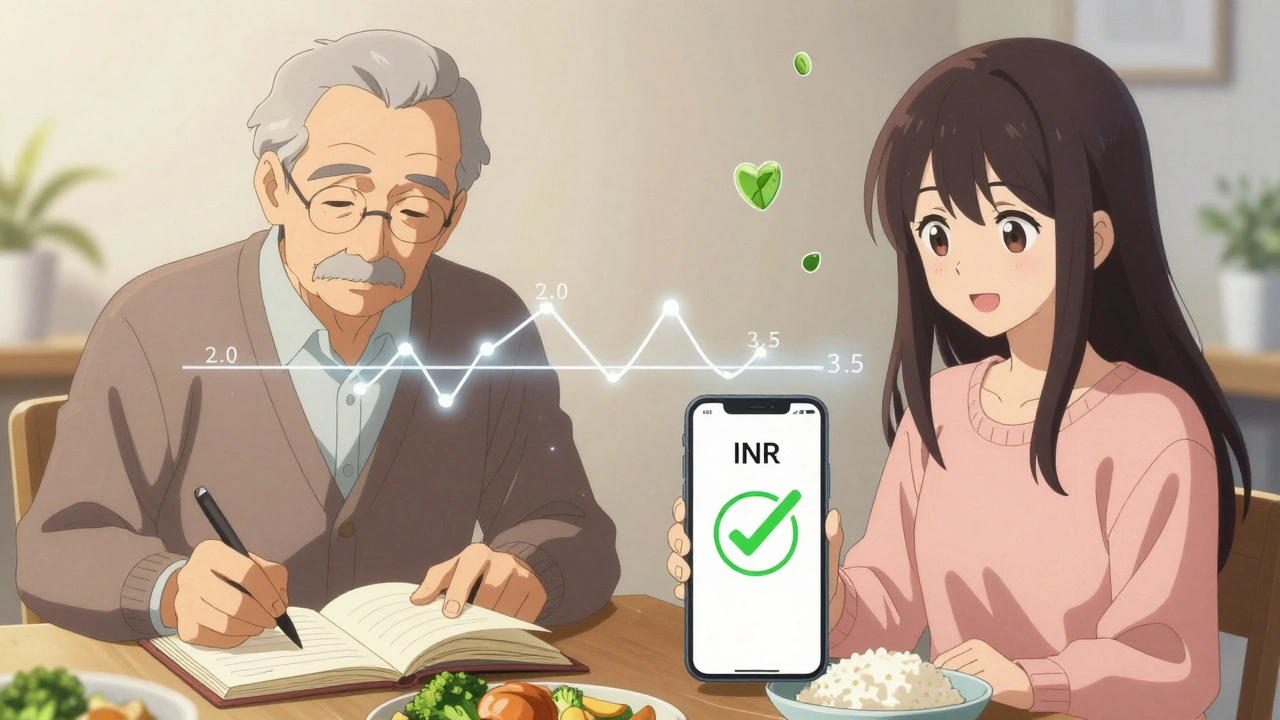
Warfarin works by blocking vitamin K, a nutrient your body needs to make clotting factors. Too much vitamin K? Your INR drops. Too little? Your INR spikes. Either way, you’re at risk-for clots or bleeding. The goal? Keep your INR steady between 2.0 and 3.5. And the best way to do that? Track your vitamin K intake every day.
What Is Vitamin K, Really?
Vitamin K isn’t one thing. It’s two main forms: K1 (phylloquinone) from plants, and K2 (menaquinones) from animal and fermented foods. For warfarin users, K1 is the big player. It’s in leafy greens, broccoli, and certain oils.
Here’s what you’re really up against:
- 1 cup cooked kale: 817 mcg of vitamin K
- 1 cup cooked spinach: 483 mcg
- 1 cup cooked broccoli: 220 mcg
- 2 cups raw romaine lettuce: 138 mcg
That’s more than your daily need-even if you’re not on warfarin. The problem isn’t eating these foods. It’s changing how much you eat from day to day. One day you eat a big salad. The next, you skip greens. Your INR swings. Your doctor adjusts your dose. You feel dizzy. You end up in the ER.
Why a Food Diary Works Better Than Guessing
Most people think, "I’ll just avoid spinach." But that’s not the fix. The fix is consistency. You don’t need to eat less vitamin K. You need to eat the same amount every day.
A 2022 study in Blood Advances followed 327 people on warfarin. Those using a digital food diary kept their INR in the safe range 72% of the time. Those using paper logs? Only 62%. That’s a 10% difference in safety.
Why? Because tracking makes you aware of hidden sources:
- Soybean oil in salad dressings
- Canola oil in baked goods
- Ensure shakes (25 mcg per serving)
- Multivitamins (some have 25-100 mcg)
Without a diary, you forget. You eat a sandwich with canola oil mayo. You take your vitamin. You don’t connect the dots. Your INR jumps. You pay for it.

Paper vs. Digital Diaries: What Works Best
There are two ways to track: paper or app. Both work-but they suit different people.
Paper diaries are simple. You write down what you ate, the portion, and your INR. The Anticoagulation Forum’s template has columns for date, food, amount, estimated vitamin K, and INR. They’re free, don’t need batteries, and work for people who don’t use smartphones. But they’re easy to lose. One patient told me his diary got soaked in his pocket. Two weeks of data gone.
Digital diaries are smarter. The Vitamin K Counter & Tracker app (iOS, $2.99 one-time fee) scans over 1,200 foods using USDA data. It shows you daily totals, trends, and alerts you when you’re going off track. Users say it cuts INR swings from monthly to quarterly. It’s not perfect-some international foods aren’t in the database. But it’s accurate. A 2021 study at the University of Toronto found it matched lab results 95% of the time.
Here’s the catch: older adults struggle. A 2022 study found only 57% of patients over 75 stuck with apps. But 82% kept using paper. So if you’re not tech-savvy, paper still works. Just be consistent.
What to Track (And What to Ignore)
You don’t need to log every bite. Focus on these:
- Green leafy vegetables (kale, spinach, collards, Swiss chard)
- Cruciferous veggies (broccoli, Brussels sprouts, cabbage)
- Vegetable oils (soybean, canola, olive oil-especially in dressings)
- Fortified foods (Ensure, Boost, some meal replacement shakes)
- Multivitamins and supplements (check labels for vitamin K)
Ignore these:
- Fruits (except avocado, which has a little)
- Meat, dairy, eggs (low in K1)
- Grains, pasta, bread (unless they’re fortified)
Portion size matters more than you think. A "small" salad isn’t always small. One cup cooked greens = 1 serving. Two cups raw = 1 serving. Use your hand as a guide: a fist = about 1 cup. A deck of cards = 3 oz of meat. Visual tools from your clinic can cut estimation errors by 41%.
Real Stories: What Patients Actually Do
On Reddit’s r/Anticoagulants, one user said: "I used to change my warfarin dose every two weeks because my INR was all over the place. After I started tracking broccoli portions with the app, my dose hasn’t changed in 8 months." Another wrote: "I tried the app but hated typing everything in. I switched back to paper and keep it in my purse. I write it down after dinner. It’s slow, but I never miss a day." The pattern? People who stick with it-paper or app-see fewer doctor visits, fewer dose changes, and less anxiety.
How to Start (And Stick With It)
Here’s how to make this work:
- Choose your tool: paper log or app. Ask your clinic for a template if you’re unsure.
- Track for 30 days straight. Don’t skip. Even if you eat the same thing every day, write it down.
- Bring your diary to every INR check. Your provider will compare it with your blood results.
- Plan meals ahead. If you know you’re having kale on Tuesday, plan to eat it every Tuesday. Consistency beats perfection.
- Check your multivitamin. If it has vitamin K, take it at the same time every day-ideally with your warfarin.
Most clinics now offer a 15-20 minute orientation. Use it. Ask for portion guides. Ask for a dietitian if they’re available. You’re not alone. 89% of anticoagulation clinics in the U.S. now require some form of dietary tracking.
The Bigger Picture: What’s Next
Technology is catching up. In January 2024, the FDA approved NutriKare-a system that takes a photo of your food and estimates vitamin K content with 89% accuracy. Epic’s MyChart platform now integrates food logs directly into your medical record. By late 2024, your doctor might see your broccoli intake and predict your INR before you even get your blood drawn.
But the core hasn’t changed. Warfarin isn’t going away. It’s still the only option for people with mechanical heart valves. And for them, food diaries aren’t optional. They’re the difference between living safely and ending up in the hospital.
Final Tip: Don’t Change Your Diet-Just Keep It the Same
Doctors don’t tell you to stop eating spinach. They tell you to eat the same amount every day. One serving. Every day. That’s it.
Consistency is your shield. Your diary is your weapon. Use it every day. Your INR will thank you.
Can I eat spinach if I’m on warfarin?
Yes, you can eat spinach-but only if you eat about the same amount every day. One cup cooked spinach has nearly 500 mcg of vitamin K. If you eat it every Tuesday and Thursday, your body adjusts. If you eat it one week and skip it the next, your INR will swing dangerously. Consistency matters more than avoidance.
Do I need to track every food I eat?
No. Focus only on foods high in vitamin K1: leafy greens, broccoli, Brussels sprouts, soybean oil, canola oil, and fortified drinks like Ensure. You don’t need to log fruit, meat, rice, or bread unless they’re fortified. Keep it simple.
What if I forget to log one day?
Don’t panic. Just resume the next day. But don’t make it a habit. Missing logs means your doctor can’t see patterns. If you miss more than two days a week, switch to a simpler method-like writing down just your greens and oils at dinner time.
Are free food tracker apps good enough?
Most aren’t. A 2023 study found 68% of vitamin K apps lack clinical validation. Apps like MyFitnessPal often misestimate vitamin K by 30% or more. Stick with apps built for anticoagulation, like Vitamin K Counter & Tracker or Vitamin K-iNutrient. They’re more accurate and worth the small cost.
How long should I keep using a food diary?
As long as you’re on warfarin. Even after your INR stabilizes, your diet can still throw it off. A sudden change-like eating a big batch of kale salad after a vacation-can spike your INR. Keep tracking. It’s not a phase. It’s part of your daily routine, like brushing your teeth.


