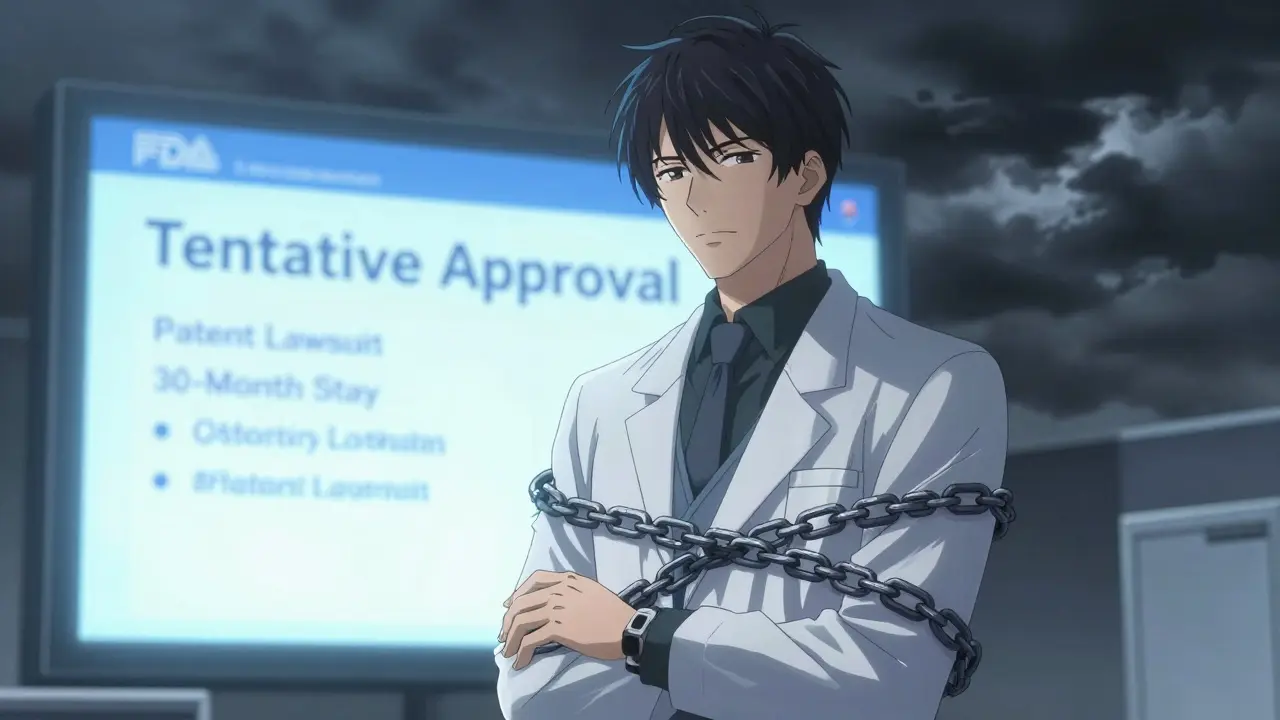
When a generic drug gets tentative approval from the FDA, it doesn’t mean it’s ready to hit pharmacy shelves. It means the FDA has reviewed the application and found it scientifically sound - but something else is blocking it from being sold. This happens all the time. Over 2,500 generic drug applications have received tentative approval since the system began, yet many sit on the shelf for years. Why? The gap between approval and market launch isn’t a glitch - it’s built into the system. And for patients waiting for affordable medicine, those delays cost money, time, and sometimes health.
Patent Locks Are the Biggest Barrier
The most common reason a tentatively approved generic never launches? A patent. Even if the FDA says the drug is safe, effective, and identical to the brand-name version, the law can’t let it be sold until the brand’s patent expires. But here’s the catch: brand-name companies don’t always just wait. They file lawsuits. And when they do, the FDA is legally required to block final approval for up to 30 months - no matter how ready the generic is.This is called the 30-month stay. Between 2010 and 2016, 68% of tentatively approved generics got stuck because of these lawsuits. Sometimes, the patent claims are weak. Sometimes, they’re just fishing expeditions. But the system lets them work. A 2017 Commonwealth Fund analysis showed that even when the FDA found no legal basis for the patent, the delay still happened. The generic manufacturer had to wait. Patients had to pay more.
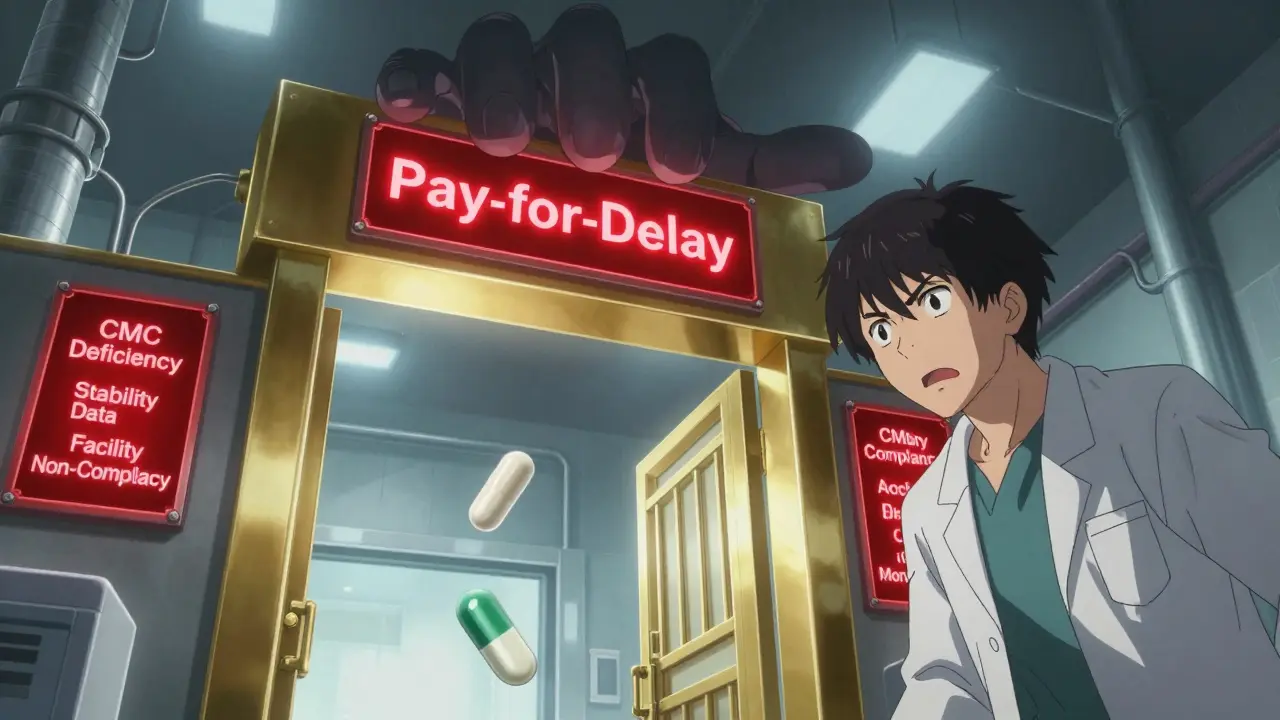
And it gets worse. Some brand companies use something called “product hopping” - making a tiny change to the drug, like switching from a pill to a liquid, and getting a new patent. That resets the clock. A 2018 FTC study found this trick was used on 17% of the top-selling brand drugs. Then there’s “pay-for-delay” deals, where the brand pays the generic maker to stay off the market. Between 2009 and 2014, these deals delayed 987 generic launches. The FTC called them anti-competitive. The courts called them legal - for now.
Applications Are Often Incomplete - And That Costs Time
Even before patents come into play, many generic applications are sent in incomplete. The FDA doesn’t reject them outright - they send back a “complete response letter” (CRL) listing what’s missing. And the list is long.Chemistry, manufacturing, and controls (CMC) sections are the most common problem. About 35% of all deficiencies come from here. That means the generic maker didn’t clearly explain how they made the drug, what equipment they used, or how they tested for purity. For complex drugs - like inhalers, creams, or extended-release pills - this gets even messier. These types of products need 2.3 times more review cycles than simple pills.
Stability data is another big gap. The FDA needs proof the drug won’t break down over time. In 2022, 43% of CRLs cited missing or inadequate stability studies. Container closure systems - the vials, caps, and packaging - were wrong in 31% of cases. These aren’t small details. If the packaging lets moisture in, the drug can go bad. The FDA won’t approve that.
And then there’s the response time. When the FDA sends a CRL, the company has six months to fix it. But in 2022, the average time to respond was 9.2 months. That’s not a typo. That’s over three extra months of delay - just from slow replies. Some companies wait because they’re waiting for a better market. Others are under-resourced. Either way, the clock keeps ticking.
Factory Problems Keep Drugs Off the Shelf
A drug can be perfectly formulated, but if it’s made in a factory that doesn’t meet FDA standards, it won’t get final approval. That’s why manufacturing inspections are so critical. In fiscal year 2022, 41% of all CRLs were because of facility issues.The most common problem? Inadequate quality control systems. That’s 63% of all facility-related CRLs. It means the company didn’t have proper checks in place to catch bad batches. Environmental monitoring failures - like not tracking mold or bacteria in the air - came up in 29% of cases. Equipment wasn’t properly tested or cleaned in 24% of cases.
These aren’t hypothetical risks. In 2018, a major generic manufacturer had to recall 10 million pills because their factory didn’t control moisture levels. The drug was fine - until it wasn’t. The FDA doesn’t want that to happen again. So they inspect. And if they find problems, they stop the approval - even if everything else is perfect.
Market Economics Don’t Always Add Up
Even when patents expire and factories pass inspection, some generics still don’t launch. Why? Because it doesn’t make financial sense.A 2022 analysis from DrugPatentWatch found that 30% of tentatively approved generics never reach the market. For drugs with annual U.S. sales under $50 million, that number jumps to 47%. If the profit margin is too thin, companies walk away. They’d rather invest in a drug that will sell in higher volumes.
And sometimes, they wait. Generic manufacturers don’t always rush to launch on day one after patent expiry. They wait for the right moment - when competitors are scarce, or when the brand’s price has dropped enough to make a price war worth it. A 2020 FDA survey showed that 62% of complex generics - like nasal sprays or injectables - had launch delays longer than a year, even after approval. That’s not because they couldn’t make the drug. It’s because they chose not to.
Even when generics do launch, prices don’t always drop fast. A 2019 JAMA study found that if only one generic enters the market, the price stays at 80% of the brand’s price for two full years. That discourages other companies from entering. Fewer competitors mean slower price drops. And patients pay the price.
The FDA Is Trying to Fix This - But It’s Hard
The FDA knows the system is slow. That’s why they created GDUFA - the Generic Drug User Fee Amendments. Since 2012, this program has given the FDA more money to hire reviewers and set deadlines. They aimed to cut review cycles from nearly four to 2.5. In 2022, they got it down to 3.2. Progress - but not enough.They also created the Competitive Generic Therapy (CGT) pathway. If a drug has little or no generic competition, it gets priority review. About 78% of CGT-designated drugs got tentative approval in under eight months - half the normal time. That’s a win.
But the FDA’s own 2023 report admits: “Ongoing challenges with complex product development, patent litigation strategies, and resource constraints will continue to impact tentative approval timelines through at least 2025.” They’re trying. But they’re up against billion-dollar pharmaceutical companies with teams of lawyers, lobbyists, and patent experts.
Legislation like the CREATES Act (2019) tries to stop brand companies from blocking access to samples needed for testing. The Affordable Drug Manufacturing Act (2023) pushes for more U.S.-based generic production. But these are long-term fixes. The delays today? They’re still happening.
What This Means for Patients
Behind every delay is a person who can’t afford their medicine. A diabetic waiting for cheaper insulin. A cancer patient needing affordable chemo. A senior on fixed income skipping pills because the brand version costs $300 a month.Tentative approval sounds like a step forward. But without final approval, it’s just paperwork. The system was meant to speed up access to affordable drugs. Instead, it’s become a maze of patents, paperwork, and profit motives.
There’s no magic fix. But awareness helps. When you see a drug with “tentative approval” listed, know this: it’s not ready. And if it’s been sitting that way for years, someone - somewhere - is holding it back.
What does tentative approval mean for a generic drug?
Tentative approval means the FDA has reviewed the generic drug application and found it meets all scientific and quality standards for safety, effectiveness, and manufacturing. But the drug cannot be sold yet because of legal barriers - like active patents or regulatory exclusivity on the brand-name version. It’s a green light for the science, but a red light for the market until those legal blocks expire.
Can a tentatively approved generic be sold in the U.S.?
No. Tentative approval is not final approval. The FDA cannot authorize the sale of a generic drug until all patent protections and exclusivity periods for the brand-name drug have expired. Even if the generic is ready to manufacture, it remains legally blocked until those barriers are removed.
How long does it usually take from tentative approval to market launch?
The median time from tentative approval to market launch is about 16.5 months, according to FDA data from 2022. Some generics launch within months if patents expire quickly. Others wait years - especially if patent lawsuits are filed or if the manufacturer delays the launch for business reasons. About 22% of tentatively approved generics never launch at all.
Why do some generic drugs never reach the market even after approval?
Even after final approval, some generics don’t launch because the market isn’t profitable enough. If the brand drug’s annual sales are below $50 million, there’s a 47% chance no generic will enter. Companies also wait for optimal pricing conditions or avoid markets with too many competitors. Manufacturing costs for complex drugs - like inhalers or creams - can be so high that the profit margin doesn’t justify the investment.
What is the role of citizen petitions in delaying generic drugs?
Citizen petitions are formal requests to the FDA asking them to delay approval of a generic drug, often by questioning its safety or bioequivalence. Between 2013 and 2015, 67 petitions were filed - mostly by brand-name companies. The FDA approved only three. But the delay worked: each petition added an average of 7.2 months to the approval timeline. These petitions are often scientifically weak but legally effective at slowing down competition.


