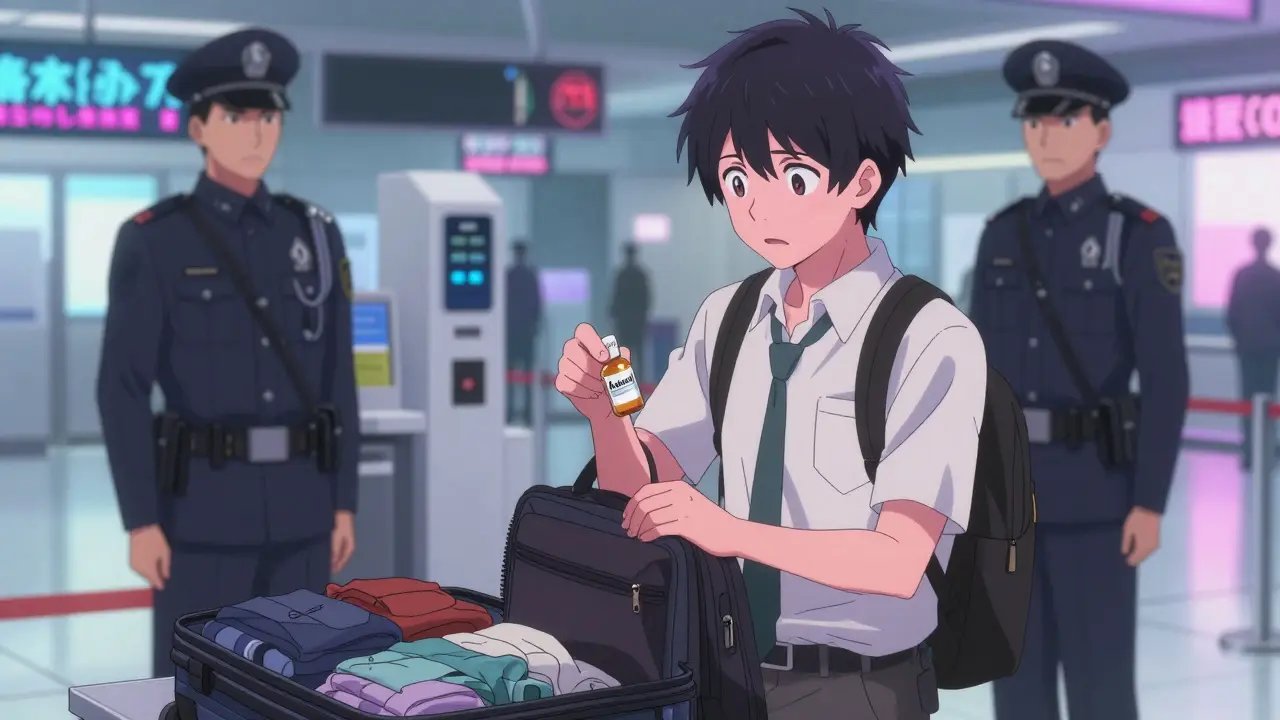
You packed your pills, printed your prescriptions, and double-checked your dosage. But what if your morning antidepressant, your painkiller for back pain, or your ADHD medication is illegal in the country you’re flying to? It’s not a hypothetical. Every year, thousands of travelers get arrested, detained, or have their meds confiscated-not because they’re doing anything wrong, but because they didn’t check.
What You Think Is Legal Might Be a Crime Abroad
In the U.S., codeine cough syrup, Adderall, and even Sudafed are easy to get at the pharmacy. But in places like Japan, the UAE, Singapore, and Thailand, these same medications are classified as narcotics. Carrying them-even with a doctor’s note-can land you in jail. Japan bans all amphetamine-based drugs, including Adderall and Ritalin. No exceptions. In 2023, over 1,200 travelers were stopped at Japanese airports just for carrying decongestants like pseudoephedrine. In the UAE, carrying more than a 30-day supply of diazepam (Valium) or codeine without prior approval is a felony. Penalties? Up to three years in prison. In Thailand, stimulants like methylphenidate carry fines of up to $28,500 and prison terms of 5 to 10 years. The U.S. has the most extensive list of banned substances globally-with 562 controlled drugs listed by the DEA. But other countries have their own lists, often stricter. Germany allows only a 30-day supply of controlled meds. China outright bans ADHD medications in all provinces. Egypt requires a special permit for even common pain relievers containing tramadol.Top 5 Medications That Get You in Trouble
Here are the most common medications that cause problems abroad, based on CDC data and traveler reports:- ADHD medications (Adderall, Ritalin, Concerta): Banned in 69% of countries surveyed, including Japan, UAE, Singapore, and China.
- Painkillers with codeine or hydrocodone (Tylenol 3, Vicodin): Illegal in 9 of the 16 most restrictive countries. The UAE and Thailand treat these like heroin.
- Sedatives and anti-anxiety meds (Xanax, Valium, Klonopin): Prohibited in over half of the countries on this list. Even a few pills can trigger a full customs search.
- Decongestants with pseudoephedrine (Sudafed, Vicks inhalers): Banned in Japan and several Southeast Asian nations. They’re flagged because they can be used to make methamphetamine.
- Sleep aids (Ambien, zolpidem): Illegal in countries like Qatar and Saudi Arabia, even if prescribed for jet lag.
Why Do These Rules Exist?
These aren’t random laws. They’re based on international treaties-the 1961 Single Convention on Narcotic Drugs, the 1971 Psychotropic Substances Convention, and the 1988 UN Drug Convention. Countries use them to stop drug trafficking. But the rules don’t distinguish between recreational users and people who need these meds for chronic pain, depression, or ADHD. The UAE, for example, has 17 airport screening points with advanced spectrometry machines that detect 98.7% of controlled substances. Japan’s customs officers are trained to spot even tiny amounts of banned stimulants. In some countries, the mere presence of a pill bottle without the original prescription can be enough for detention.How to Avoid Getting Arrested
There’s no shortcut. You must plan ahead. Here’s what to do:- Start 8-12 weeks before travel. Don’t wait until the airport. Some countries take up to two weeks to approve your meds.
- Check your meds against the destination country’s list. Use the CDC’s Travelers’ Health site or the UAE’s Medicines for Patients portal. Don’t rely on Google.
- Get a doctor’s letter. It must be on official letterhead, signed, and include your diagnosis, the medication name, dosage, and reason for use. Translation may be required-Italy demands Italian translations.
- Carry original prescriptions. Not pharmacy labels. Not copies. The original bottle with your name and the doctor’s info.
- Apply for pre-approval if needed. The UAE requires it for codeine, diazepam, and methylphenidate. Japan requires an International Certificate for Psychoactive Substances, which you must get from your home country’s health authority within 30 days of travel.
- Carry only what you need. Japan limits you to a 3-month supply. Germany says no more than 30 days. Don’t pack a year’s supply.
What Happens If You Get Caught?
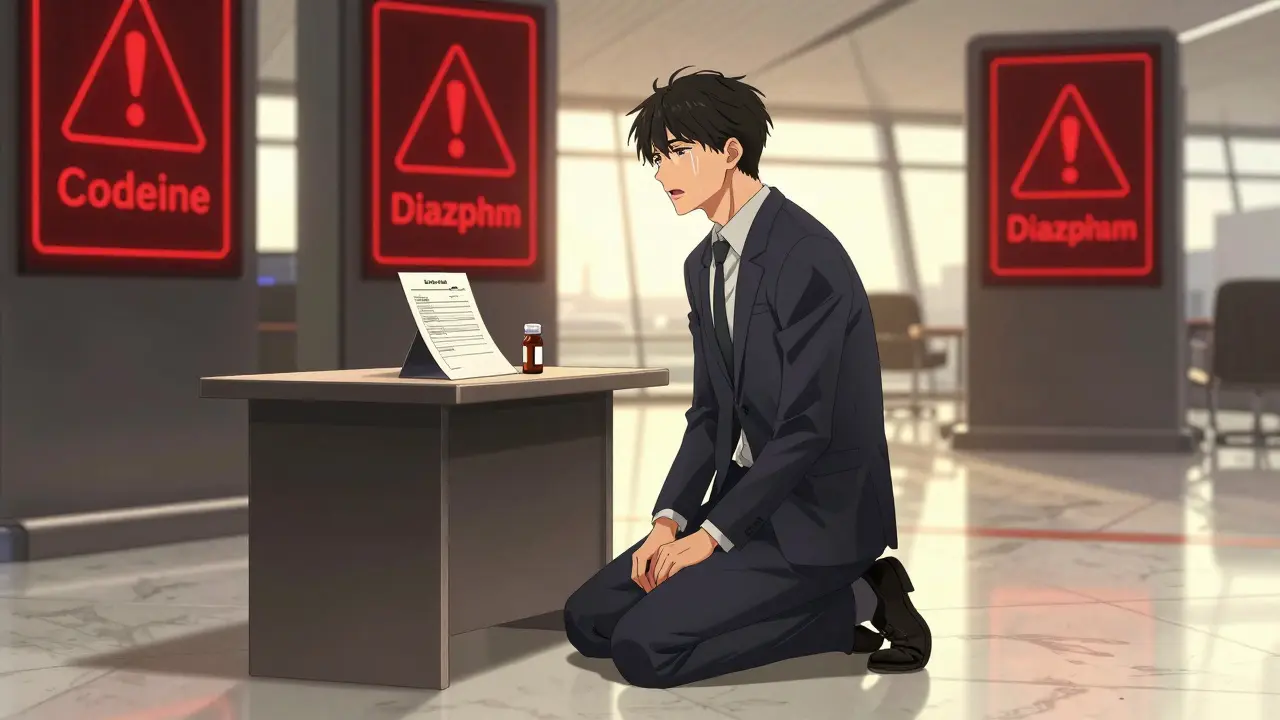
In the best case, your meds are confiscated and you’re sent on your way with a warning. In the worst case, you’re detained for days, fined thousands, or jailed. One traveler in Dubai was held for 72 hours after customs found 10 codeine tablets in his bag. He had a prescription, but no pre-approval. Another in Tokyo had his Adderall taken away-even though he showed his doctor’s note and had a 30-day supply. Japan doesn’t make exceptions. The CDC recorded 1,842 medication-related incidents globally in 2023. The most common? ADHD meds (29.7%), painkillers (24.3%), sedatives (18.6%), and decongestants (15.2%).What About Travel Insurance?
Most travel insurance policies won’t cover you if you’re arrested for carrying illegal drugs-even if they’re legal at home. But some companies, like Allianz, now offer add-ons specifically for medication-related travel issues. These can cover emergency replacements or legal fees if you’re detained. Check your policy. Ask your provider. Don’t assume you’re covered.Is There a Better Way?
Some travelers use services like DocHQ’s Travel Medicine Checker, which helped reduce documentation errors by over 70% in 2023. Others work with travel clinics that specialize in international medication compliance. These services aren’t cheap, but they’re cheaper than a prison cell. The good news? Awareness is growing. The U.S. State Department now includes medication warnings in 87.5% of its country advisories. The UK launched its Medicines Abroad portal in 2022, and over a million people have used it. Travel agencies are starting to offer medication checks as part of their packages. But it still falls on you.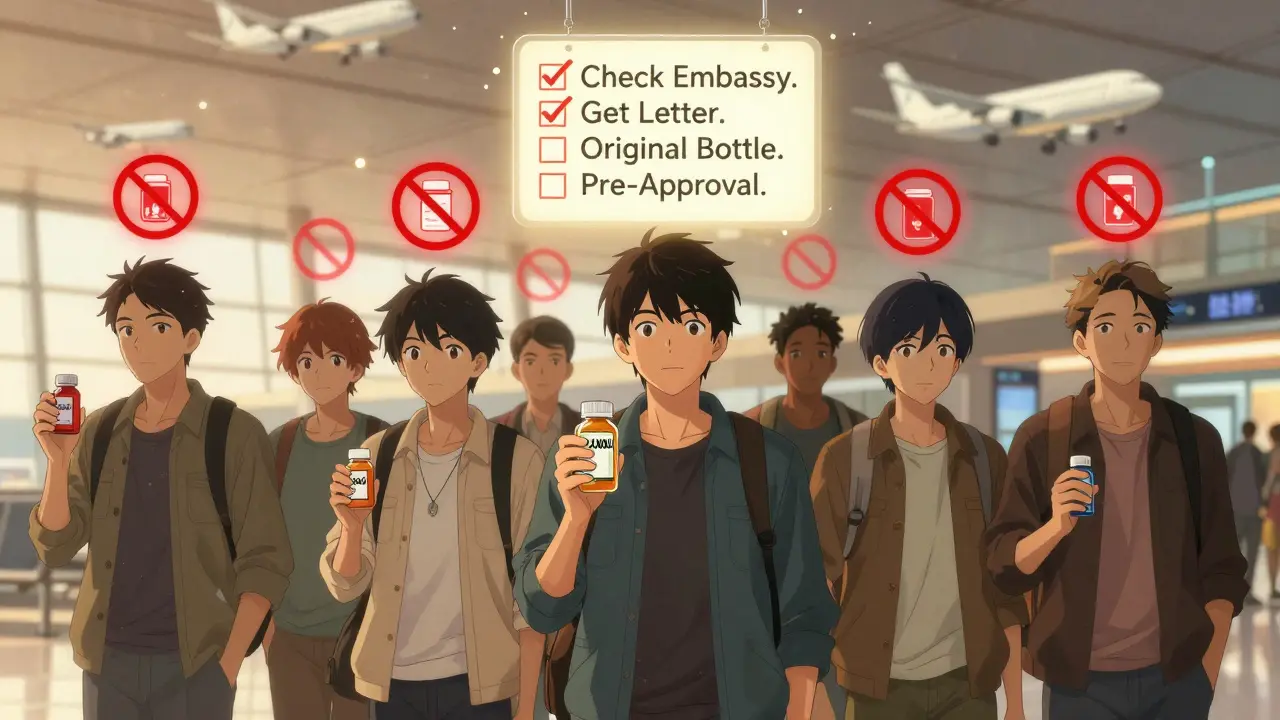
Final Checklist Before You Fly
Before you leave:- ✅ List every medication you take, including supplements and OTC pills.
- ✅ Check each one against the destination country’s official health website.
- ✅ Contact the embassy or consulate if you’re unsure.
- ✅ Get a doctor’s letter and original prescriptions.
- ✅ Apply for pre-approval if required (UAE, Japan, Philippines).
- ✅ Pack meds in your carry-on-not checked luggage.
- ✅ Bring extra copies of all documents.
Frequently Asked Questions
Can I bring my prescription meds in my carry-on?
Yes, always. Never pack prescription medications in checked luggage. Customs officers may open bags, and if your meds are missing or damaged, you’ll have no proof you were carrying them legally. Keep them in your original bottles with the prescription label, and carry a printed copy of your doctor’s letter.
What if my medication is banned but I need it?
Contact the destination country’s embassy or health ministry before you travel. Some countries allow exceptions for medical necessity with prior approval. For example, Japan now permits 6-month supplies of certain controlled meds with a special permit. The UAE has an online portal for pre-approval. Don’t assume you can’t get it-just don’t wait until you’re at the airport.
Are over-the-counter meds safe to bring?
No. Many OTC drugs in the U.S. and Europe contain banned ingredients. Sudafed (pseudoephedrine), certain cough syrups with codeine, and even some allergy pills with diphenhydramine are restricted in countries like Japan, Thailand, and the UAE. Always check the active ingredients, not just the brand name.
Do I need a translation of my prescription?
It depends. Countries like Italy, Spain, and Japan require official translations of prescriptions and doctor’s letters. Some require notarization. Check the destination country’s official travel health site. If you’re unsure, get it translated and notarized-it’s a small cost compared to the risk.
Can I refill my prescription abroad?
Almost never. Even if your medication is legal in the country, pharmacies won’t fill a foreign prescription. You need a local doctor’s prescription, which usually requires a local diagnosis. If you’re traveling long-term, plan ahead-get approval for a larger supply before you leave, or arrange to see a local doctor before your meds run out.


