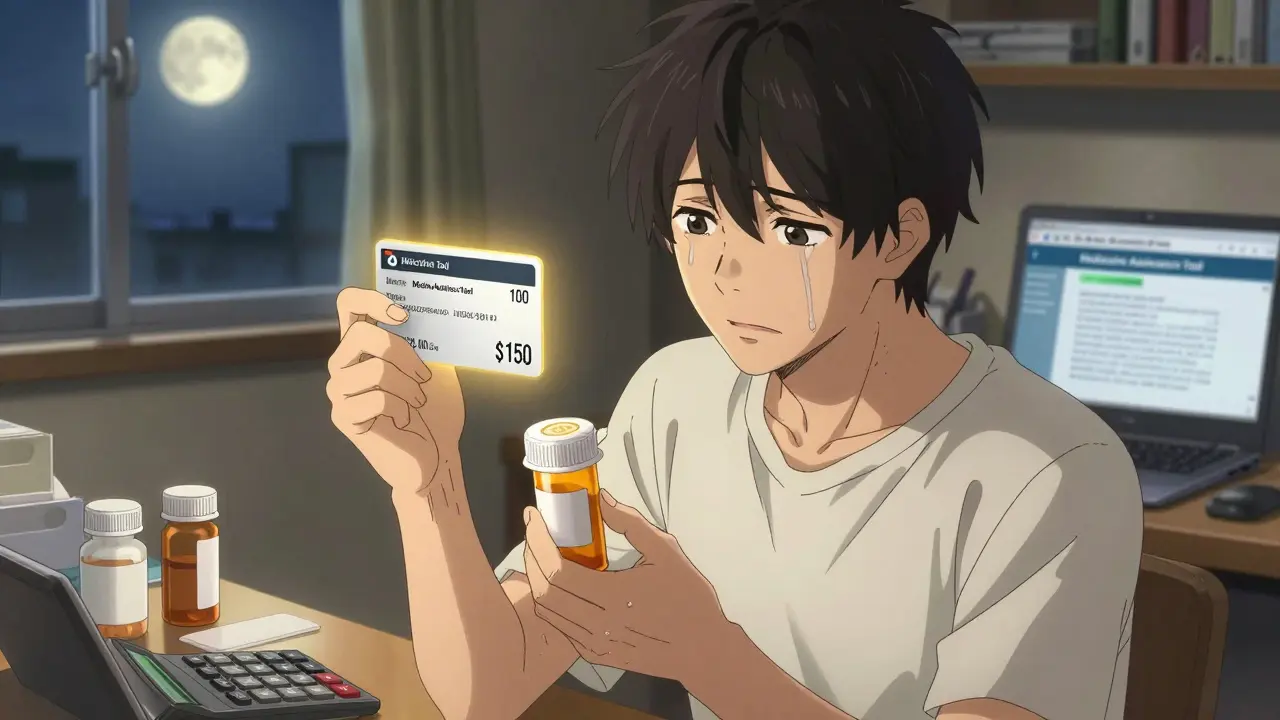
Buying prescription meds shouldn’t feel like a lottery. You get the script, walk to the pharmacy, and then-boom-your copay is $300. For many, that’s not just expensive. It’s impossible. That’s where prescription assistance programs come in. These aren’t government handouts. They’re direct support from the drug companies themselves-Pfizer, Merck, Eli Lilly, and others-who’ve built programs to help people actually get the medicines their doctors ordered.
Two Types of Help: Copay Cards vs. Patient Assistance Programs
There are two main ways drug makers help. One is for people with insurance. The other is for those without.Copay assistance programs are coupons or cards you show at the pharmacy. They cover part-or all-of your copay for brand-name drugs. If your insurance says you owe $150 for a diabetes med, the copay card might knock that down to $10. Some even cover $0 if you qualify. These are mostly for specialty drugs: things like biologics for rheumatoid arthritis, cancer treatments, or rare disease meds. About 85% of specialty drugs now offer some kind of manufacturer copay help, according to PhRMA’s 2023 report.
Patient Assistance Programs (PAPs) are different. They’re for people who don’t have insurance-or have insurance that doesn’t cover their meds. If you make under 400% of the Federal Poverty Level (about $60,000 a year for a family of four in 2023), you might get your meds for free. Some programs give you a 90-day supply. Others send refills every month. These programs started back in the 1980s during the HIV/AIDS crisis and have grown since. In 2022 alone, drug makers gave out $24.5 billion in assistance through PAPs, helping 12.7 million people.
Who Can Get Help? It’s Not as Simple as It Sounds
You’d think if you’re struggling to pay, you’d qualify. But eligibility rules are messy.For copay cards: You need insurance. But not just any insurance. Some health plans, especially Medicaid in 78% of states, block these cards entirely. Why? Because they argue it pushes patients toward pricier brand-name drugs instead of cheaper generics. And even if your plan allows it, some have “copay accumulator” rules-meaning the card’s savings don’t count toward your deductible. So you pay less now, but you’re still far from hitting your out-of-pocket max.
For PAPs: You usually can’t have Medicare or Medicaid. That’s right. Even if you’re on Medicare Part D and your drug costs $500 a month, most manufacturer PAPs won’t help you. The government says these programs must operate “outside the Part D benefit,” and the savings don’t count toward your catastrophic coverage. That means you stay stuck in the coverage gap longer. Some PAPs require you to prove you have no other drug coverage-so if you have even a tiny supplemental plan, you might be turned away.
And income limits vary. One program might accept up to 300% of the poverty line. Another might cap it at 200%. Some ask for tax returns. Others want two recent pay stubs. A few even require a doctor’s letter saying the drug is medically necessary. It’s not just paperwork-it’s time. The average application takes 45 to 60 minutes per program, according to the NIH.
What You Actually Save-Real Numbers
Let’s get specific. Not vague promises. Actual numbers.For asthma patients on Dulera: Teva’s PAP lets you pay as little as $15 per prescription, with up to 12 refills covered per year. That’s $90 saved per dose. For insulin? Some programs give you 30-day supplies for $35 or less-down from $250 or more. One 2024 report from the Asthma and Allergy Foundation of America found that patients using copay cards for specialty inhalers saved an average of 75% per fill.
But here’s the catch: these savings are only for brand-name drugs. If a generic exists, most programs won’t help you switch. That’s because manufacturers don’t make generics. They make the expensive version. So even if the generic costs $20, your copay card won’t cover it. You’re stuck paying more for the name-brand drug.
And there’s a cap. About 45% of copay programs have an annual dollar limit-anything from $1,000 to $25,000. If your drug costs $5,000 a month and your card covers $3,000, you’ll hit that limit in less than a year. Then you’re back to full price.

The Big Problem: It’s Not Helping Everyone
There are 28 million Americans without health insurance as of 2023. Millions more have plans with high deductibles. They need help. But the system doesn’t reach them evenly.Only 37% of eligible patients even know these programs exist, according to the Patient Advocate Foundation. That’s less than two in five. Why? Because doctors don’t always mention them. Pharmacies don’t always explain them. And the websites? They’re buried under ads and confusing forms.
Plus, the programs are designed for people who can navigate bureaucracy. If you’re working two jobs, can’t take time off, don’t have a computer, or don’t speak English well, you’re at a disadvantage. The system assumes you have the time, resources, and knowledge to fill out forms, gather documents, and follow up. For many, that’s impossible.
And here’s the irony: while these programs help individuals, they might be making the system worse. A 2022 JAMA Internal Medicine study found that copay assistance programs push patients toward expensive brand-name drugs-even when cheaper generics are available. That drives up overall drug spending by an estimated $1.4 billion a year. Drug makers profit. Insurance companies pay more. And the cycle continues.
How to Find and Use These Programs
You don’t have to guess. There’s a tool for this.The Medicine Assistance Tool (MAT), run by PhRMA, is free, confidential, and easy to use. Just go to the website, enter your drug name, your income, and your insurance status. It pulls up every program you might qualify for-copay cards, PAPs, even nonprofit grants. You can print the forms, save them, or apply online.
For copay cards: Print the coupon or save it on your phone. Show it at the pharmacy when you pick up your prescription. The discount applies automatically.
For PAPs: You’ll need to fill out a longer form. Usually, you’ll need:
- Proof of income (tax return, pay stubs, or benefit letter)
- Proof of residency (utility bill, lease)
- Doctor’s signature verifying the prescription is needed
- Insurance status documentation
Some programs mail you pills. Others send a card to pick up at the pharmacy. Some require reapplying every year. Others auto-renew as long as your income hasn’t changed.

What’s Changing? Regulations Are Catching Up
The government is starting to pay attention.As of January 2024, 22 states have passed laws to limit or track copay assistance. California’s SB 1424 requires drug makers to publicly report how much they spend on these programs. The federal government is also pushing for more transparency. In October 2023, HHS proposed new rules to make these programs more accountable.
Meanwhile, insurers are fighting back. More than 78% of major health plans now use “copay accumulator” policies. That means your card’s discount doesn’t count toward your deductible. So even if you’re saving $200 a month, you’re still $2,400 away from hitting your out-of-pocket max. That’s a hidden cost you might not even realize.
Is This the Answer? Or Just a Band-Aid?
Let’s be honest: these programs are lifesavers-for some. But they’re not a fix.They’re temporary. They’re patchy. They’re confusing. And they don’t touch the root problem: drug prices are too high. The fact that 92% of major drug makers run these programs says something: the market can’t function without them. Patients can’t afford their meds. Insurers can’t absorb the costs. So the manufacturers step in.
But if you’re on Medicare and your insulin costs $400, you’re still stuck. If you’re uninsured and make $35,000 a year, you might qualify for one program but not another. If you’re a single parent working nights, you might not have time to apply.
These programs help people survive. But they don’t fix the system.
Still-for now-they’re the best option many have. If you’re struggling to pay for meds, don’t assume you’re out of luck. Check MAT. Talk to your pharmacist. Ask your doctor. Someone out there is offering help. You just have to look.
Frequently Asked Questions
Can I use a copay card if I have Medicare?
No, most manufacturer copay cards cannot be used with Medicare Part D. Federal rules block them because the savings don’t count toward your True Out-of-Pocket (TrOOP) costs, which are needed to reach catastrophic coverage. Some Medicare Advantage plans may allow them, but it’s rare. Always check with your plan before using a card.
Do I qualify for a Patient Assistance Program if I have Medicaid?
Most manufacturer PAPs do not allow patients with Medicaid to enroll. The programs are designed for the uninsured. Even if your Medicaid plan doesn’t cover your drug, the manufacturer’s PAP will likely still turn you away. Some nonprofits or state programs may help instead.
How long does it take to get approved for a PAP?
Approval times vary. Some programs process applications in 3-5 business days. Others take 2-4 weeks, especially if they require doctor signatures or income verification. Start early. Don’t wait until your prescription runs out.
Can I use more than one assistance program at the same time?
Yes, but not always. You can use a copay card for one drug and a PAP for another. But you usually can’t stack multiple cards for the same medication. Also, some PAPs require you to have no other drug coverage-so if you’re already using a copay card, you might be disqualified from a PAP.
Are there programs for generic drugs?
Rarely. Manufacturer assistance programs are tied to brand-name drugs because those are the ones the companies sell. Generics are made by different companies, and they rarely offer patient assistance. But some pharmacies and nonprofits run discount programs for generics-check GoodRx or NeedyMeds.
What if I’m denied help? Is there an appeal?
Some programs allow appeals if you provide additional documentation-like a letter from your doctor explaining your financial hardship. Others don’t. If you’re denied, contact the program directly and ask why. Sometimes a simple mistake-like a missing signature or outdated income proof-is the reason. You can also reach out to patient advocacy groups like the Patient Advocate Foundation for free help.


