Pain Management Calculator for Palliative Care
This calculator helps estimate appropriate pain medication dosages while minimizing side effects. Based on clinical guidelines from the article, it provides guidance for common palliative care scenarios.
Guidance will appear here
Results will show recommended approaches based on clinical guidelines
When someone is living with a serious illness, the goal isn’t just to make them live longer-it’s to help them live better. That’s the heart of palliative and hospice care. It’s not about giving up. It’s about shifting focus from curing to caring. For many families, this transition feels confusing, even scary. What if the medicine that relieves pain also makes them too sleepy to talk? What if treating nausea causes dry mouth so bad they can’t swallow? These aren’t hypotheticals. They’re daily realities for patients and caregivers navigating advanced illness.
What’s the Difference Between Palliative and Hospice Care?
Palliative care is for anyone with a serious illness-no matter how advanced. It can start the day someone is diagnosed with cancer, heart failure, or COPD. It runs alongside treatments like chemotherapy or dialysis. The goal? Reduce suffering from symptoms like pain, breathlessness, fatigue, and anxiety. It’s not tied to prognosis. You don’t have to stop fighting to get it.
Hospice care is a type of palliative care, but it’s specific. It’s for people with a life expectancy of six months or less, and who have chosen to stop curative treatments. Hospice doesn’t mean giving up hope. It means focusing on comfort, dignity, and being present-with family, with quiet moments, with peace.
Both use the same tools: medications, therapies, emotional support. But hospice is more about wrapping care around the person and their loved ones, day and night, in the home or a dedicated facility. The difference isn’t in the methods-it’s in the timing and the mindset.
How Do You Control Symptoms Without Over-Sedating?
Let’s talk about pain. It’s the most common reason people seek palliative care. But giving too much opioid painkiller can make someone drowsy, confused, or unable to breathe. Too little, and they suffer. The trick isn’t guessing. It’s measuring.
Clinicians use a simple 0-to-10 scale. Zero is no pain. Ten is the worst pain imaginable. But numbers alone aren’t enough. Is the pain sharp or dull? Does it spread to the back or leg? Does it get worse when they move or lie down? A North West England audit found that using detailed pain assessments reduced medication errors by 22%. Why? Because you’re treating the real pain-not just the number.
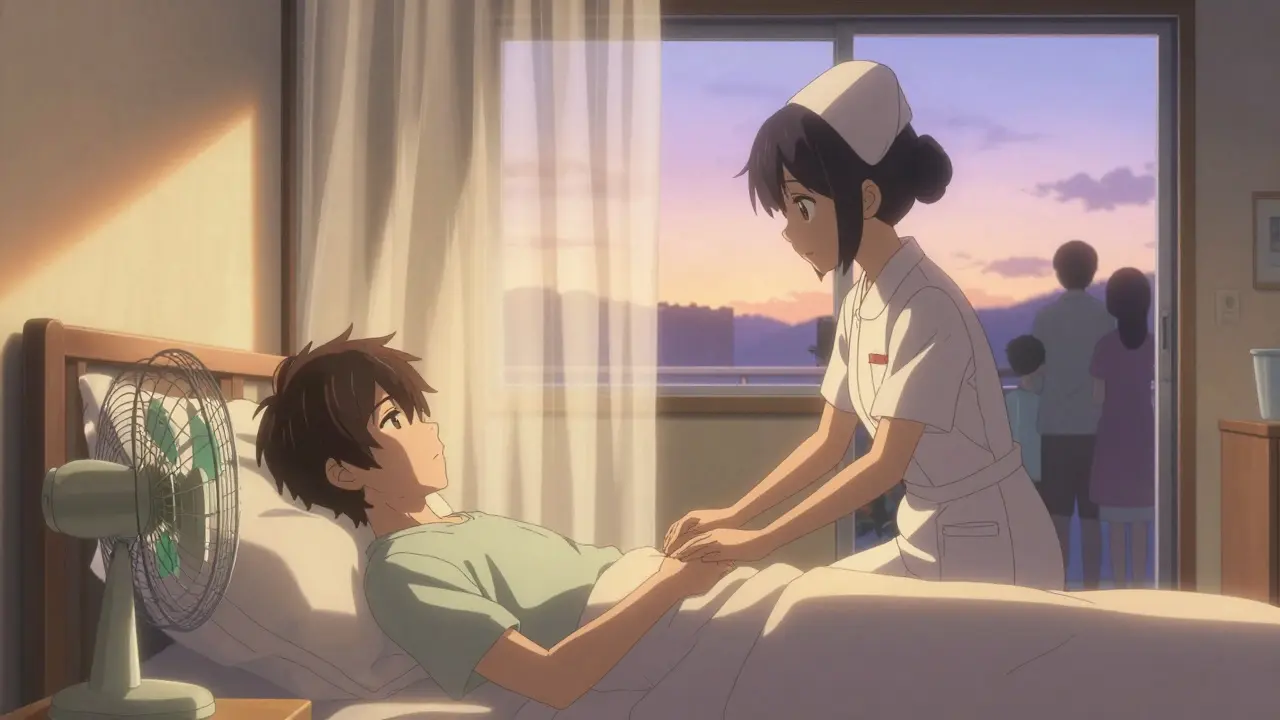
For breathlessness, opioids are often the first choice-even though they’re known for pain. Studies show they’re effective for end-of-life dyspnea. But they’re not the only tool. A fan blowing gently on the face, sitting upright, or breathing exercises can help too. Sometimes, the best medicine isn’t a pill-it’s a breeze.
Delirium is another challenge. A patient might suddenly become agitated, confused, or hallucinate. Haloperidol is commonly used, but it’s not risk-free. It can cause stiffness or irregular heart rhythms. That’s why guidelines say: check the heart with an EKG before starting, and stop the drug as soon as the person is calm. The goal isn’t to silence the mind-it’s to restore comfort.
What About Nausea, Constipation, and Other Side Effects?
Pain meds cause constipation. That’s not a side effect-it’s an expected result. And if you don’t treat it, it turns into unbearable suffering. Laxatives aren’t optional. They’re part of the plan. A daily regimen of stool softeners and stimulants is standard. Waiting until someone is in pain from constipation is too late.
Nausea is trickier. It can come from the illness itself, the meds, or even anxiety. Sometimes, a low dose of an anti-nausea drug like ondansetron helps. Other times, a small dose of a steroid like dexamethasone works better. But if the patient is vomiting constantly, you need to ask: Is this a bowel obstruction? If so, steroids are more effective than expensive drugs like octreotide-which studies show have limited benefit.
And then there’s dry mouth. It’s one of the most overlooked symptoms. Saliva doesn’t just help you swallow. It helps you speak, smile, feel human. Sipping ice chips, using saliva substitutes, or even just moistening the lips with a damp cloth can make a huge difference. No drug needed.
Why Do Families Resist Medication?
It’s heartbreaking, but common. A daughter might say, “I don’t want them to be drugged up.” A son might fear the morphine will “kill them faster.” These aren’t irrational fears. They come from movies, myths, and misinformation.
Here’s what families need to hear: Opioids don’t shorten life when used properly. In fact, untreated pain can stress the body so much that it weakens the immune system and speeds decline. The goal isn’t to knock someone out-it’s to let them be awake, present, and comfortable.
One study showed that when families received clear, compassionate education about pain control, their anxiety dropped by 40%. That’s why palliative teams don’t just hand out prescriptions. They sit down. They answer questions. They say, “You have the right to live-and die-free of pain, with dignity.” That phrase isn’t just a slogan. It’s a promise.
What Role Do Non-Medical Support Play?
Pain isn’t just physical. There’s emotional pain. Spiritual pain. The fear of being a burden. The regret of things left unsaid. These don’t show up on a pain scale-but they make physical pain worse.
Dr. Harvey Chochinov’s research found that when patients feel heard, their physical symptoms often ease. That’s why chaplains, social workers, and counselors are part of every palliative team. A simple conversation-“What are you most afraid of?” or “Is there someone you want to forgive?”-can be more powerful than a pill.
And then there’s the environment. A quiet room. Soft lighting. A favorite song. A family member holding a hand. These aren’t luxuries. They’re medicine.
One hospice nurse in Durban told me about a man who couldn’t sleep because he kept hearing his wife’s voice calling his name. He was hallucinating from delirium. The team gave him a low dose of haloperidol. But they also played recordings of his wife’s voice-reading his favorite poem. Within two days, he was calm. He didn’t need more drugs. He needed to feel connected.

How Do You Know You’re Doing It Right?
Success isn’t measured by how long someone lives. It’s measured by how they feel.
At UPenn, they track breakthrough symptoms-those sudden spikes of pain or anxiety that happen between doses. Before they started using scheduled assessments every 30 minutes for uncomfortable patients, patients had an average of 4 breakthrough episodes a day. After implementing the protocol? That dropped to 1.9. That’s a 52% reduction.
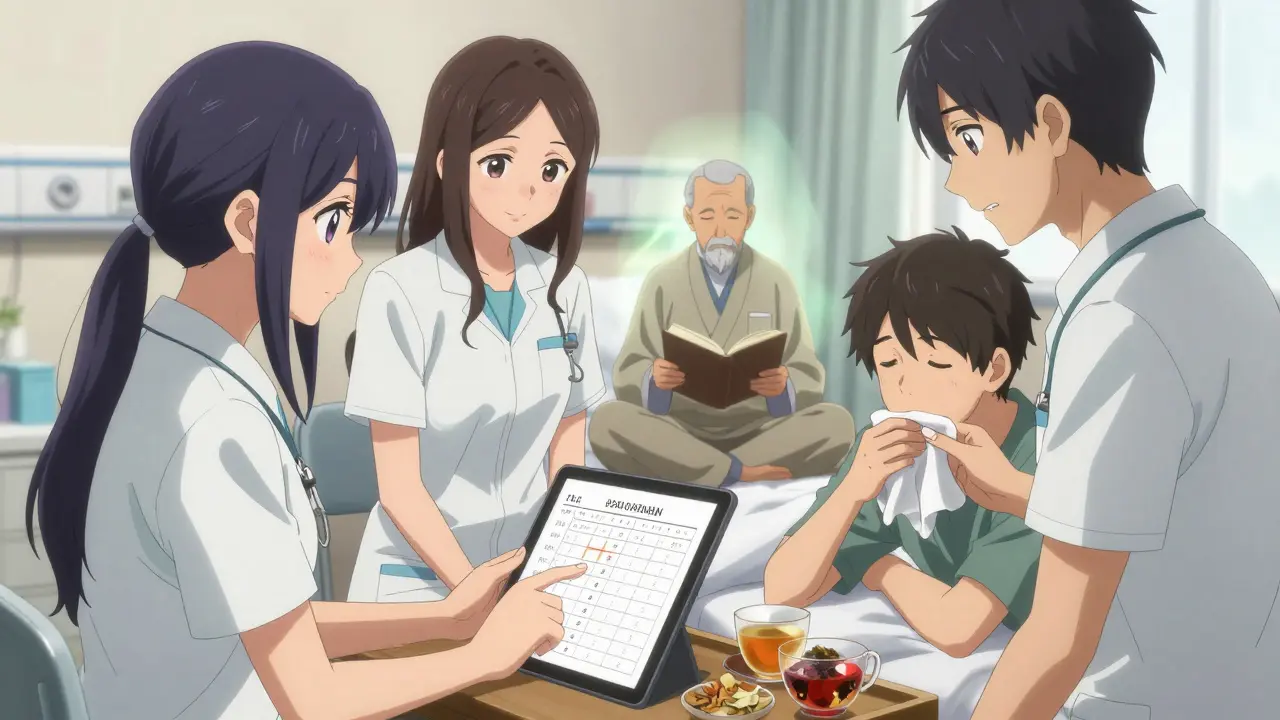
But even the best protocols fail without documentation. If you don’t write down what you gave, when, and how the patient responded, you’re flying blind. One Canadian study found that 43% of clinicians felt overwhelmed by paperwork. But skipping it risks overmedication. That’s why many teams now use simple checklists: “Medication given? Yes/No. Response? Improved/No change/Worsened.” One page. One minute. One life changed.
What’s New in 2025?
The field is evolving. In 2023, Fraser Health in Canada added guidance for medical cannabis. In a study of 152 patients, those who used cannabinoids needed 37% less opioids. But 29% reported dizziness. So it’s not a magic bullet-it’s another tool, used carefully.
Tele-palliative care is growing fast. Right now, 55% of rural counties in the U.S. have no palliative care services. By 2027, that number could drop as video visits become standard. A pilot study showed digital symptom trackers improved control by 18% because families could report changes in real time.
And research is starting to look at genetics. A 2022 study found that certain gene variants predict how someone will respond to opioids. In the future, a simple blood test might tell you whether a patient needs a low or high dose from the start. Precision care is coming.
Where Do You Start?
If you’re caring for someone with a serious illness, here’s your first step: Ask for palliative care. Don’t wait until things are desperate. The earlier you start, the better the outcomes. A landmark 2010 study in the New England Journal of Medicine found that cancer patients who got early palliative care had better symptom control and lived 3.2 months longer.
Ask your doctor: “Can we bring in a palliative care team?” Even if you’re still chasing a cure, they can help you manage side effects and answer hard questions.
If hospice is being discussed, ask: “What will this look like at home?” “Who will be here at night?” “What if symptoms get worse?” Don’t be afraid to say, “I need more time to understand.”
And remember: You don’t have to do this alone. There are trained teams-doctors, nurses, social workers, chaplains-whose only job is to help you carry the weight.
Palliative and hospice care isn’t about the end. It’s about making every moment count. With less pain. More presence. And more peace.


