
Imagine your nerves are like electrical wires coated in insulation. That insulation is called myelin. Now imagine your own immune system, the very thing meant to protect you, starts tearing that insulation off. That’s what happens in multiple sclerosis (MS). It’s not a mystery - it’s a targeted attack. And it’s happening inside your brain, spinal cord, and optic nerves.
MS isn’t just one thing. It’s a chain reaction. It starts with a breakdown in how your immune system tells the difference between your body and invaders. In people with MS, certain immune cells - mainly T cells and B cells - mistake myelin for a threat. They cross the blood-brain barrier, a normally tight seal that keeps harmful cells out of the nervous system. Once inside, they start stripping away the myelin sheath around nerve fibers. This isn’t just damage. It’s sabotage. Without myelin, electrical signals slow down or stop completely. That’s when symptoms show up.
What Happens Inside the Nervous System?
The damage isn’t random. It’s organized chaos. Research shows four different patterns of damage in MS lesions. Some show mostly T cells and macrophages chewing through myelin. Others have antibodies clinging to the debris. One pattern even shows oligodendrocytes - the cells that make myelin - dying off without a fight. In another, they’re still alive but can’t repair the damage because the environment is too toxic.
It’s not just about myelin. Axons - the actual nerve fibers - get damaged too. And once they’re gone, they don’t come back. That’s why some people with MS end up with permanent disability. The inflammation that strips myelin also crushes the underlying nerve. Studies show that in chronic lesions, 89% have activated microglia, the brain’s own immune cells, stuck in overdrive. They’re supposed to clean up debris. Instead, they keep firing off inflammatory signals, making things worse.
And it’s not just T cells. B cells are major players. They don’t just make antibodies. They pump out inflammatory chemicals like TNF-alpha and lymphotoxin. One study found B cells from MS patients produce 47% more TNF-alpha than those from healthy people. That’s not a small difference. That’s a firestarter.
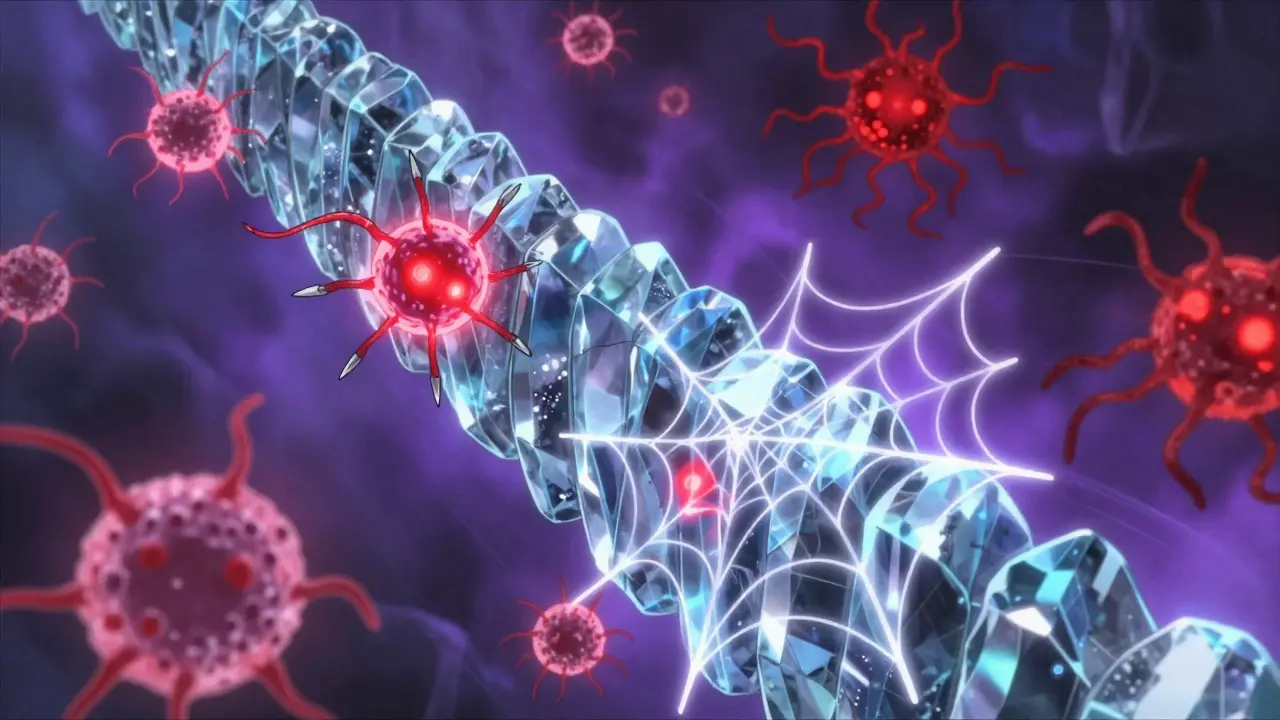
Even neutrophils - usually seen as short-term fighters - show up in MS. They release NETs, sticky webs of DNA and toxins that break down the blood-brain barrier and wake up microglia. In 78% of acute MS relapses, these NET markers are elevated. It’s a full-scale invasion, with multiple immune teams working together.
Why Does This Happen?
MS doesn’t just appear out of nowhere. It’s a mix of genes and environment. You need to be born with the right genetic setup - something about your immune system’s wiring that makes it prone to this mistake. But genes alone aren’t enough. Something has to trigger it.
The biggest trigger we know? Epstein-Barr virus. That’s the virus that causes mononucleosis. A 2022 Harvard study found people infected with EBV are 32 times more likely to develop MS. It’s not that EBV causes MS directly. It’s that the virus changes how your immune system behaves, making it more likely to turn against myelin.
Vitamin D matters too. People living farther from the equator - where sunlight is weaker - have higher MS rates. Low vitamin D levels (below 50 nmol/L) are linked to a 60% higher risk. That’s why MS is rare in equatorial regions but common in Canada, Scandinavia, and parts of the northern U.S.
Smoking? It doesn’t just hurt your lungs. It makes MS worse. Smokers with MS progress 80% faster than non-smokers. It’s not just about lung damage. Smoking changes immune cell behavior, making them more aggressive toward the nervous system.
And gender? Women get MS two to three times more often than men. The reasons aren’t fully clear, but hormones, immune response differences, and even how women’s bodies handle infections may play a role.
What Do People Actually Feel?
The symptoms aren’t just random. They map directly to where the damage happens.
- **Fatigue** - affects 80% of people. Not just tiredness. A deep, bone-deep exhaustion that doesn’t go away with rest. It’s the brain working harder to send signals through damaged wires.
- **Vision problems** - 37% experience optic neuritis. The optic nerve gets attacked. Vision blurs, turns gray, or even goes dark for days. Some describe it as looking through a fogged-up window.
- **Numbness or tingling** - 58% feel it. Usually in hands, feet, or face. It’s not a pinched nerve. It’s a broken signal. The brain isn’t getting the message from the skin.
- **Walking difficulties** - 42% struggle. Muscle weakness, poor balance, stiffness. It’s not just muscles. It’s the brain losing control over them.
- **Lhermitte’s sign** - a sharp electric shock down the spine when bending the neck. It happens when demyelinated nerves in the cervical spine fire off randomly.
These aren’t rare side effects. They’re the direct result of immune cells attacking the nervous system. And they can come and go - especially in the early years.
Types of MS: Relapsing vs. Progressive
Most people - about 85% - start with relapsing-remitting MS (RRMS). That means they have flare-ups: new symptoms that last days or weeks, then fade. During these flares, immune cells flood the CNS, creating fresh inflammation and new lesions. MRI scans show bright spots. Blood tests show rising neurofilament levels - a sign of nerve damage.
The other 15% have primary progressive MS (PPMS). No flares. Just a slow, steady decline. The immune attack here is quieter but constant. It’s more about microglia and chronic inflammation than bursts of T cells. There’s less visible lesion activity on MRI, but the damage accumulates.
Over time, many with RRMS shift to secondary progressive MS. The flares slow down, but the damage keeps building. The nervous system runs out of ways to compensate. This transition usually happens 10 to 20 years after diagnosis - though modern treatments are pushing that back.
Treatments: Stopping the Attack
Treatment today isn’t about curing MS. It’s about stopping the immune system from attacking. That’s where disease-modifying therapies (DMTs) come in.
Ocrelizumab targets B cells. It removes CD20+ B cells from circulation. In clinical trials, it cut relapses by 46% in RRMS and slowed disability in PPMS by 24%. It’s one of the few drugs approved for both forms.
Natalizumab blocks immune cells from crossing the blood-brain barrier. It reduces relapses by 68%. But it comes with a serious risk: progressive multifocal leukoencephalopathy (PML). That’s a rare brain infection caused by a virus that gets reactivated when the immune system is too suppressed. The risk? 1 in 1,000 after two years of use. That’s why doctors monitor blood for the JC virus before and during treatment.
Newer drugs are even more precise. Some target specific immune pathways, like S1P receptors, keeping T cells trapped in lymph nodes. Others block interleukin-6, a key inflammatory signal. The goal isn’t just to suppress - it’s to redirect.

The Future: Repairing the Damage
The real hope isn’t just stopping the attack. It’s fixing what’s broken.
For years, scientists thought oligodendrocytes couldn’t repair myelin in MS. Now we know they can - if the environment lets them. The problem isn’t the cells. It’s the inflammation around them.
One promising drug, clemastine fumarate, showed in phase II trials that it could improve nerve signal speed by 35% in MS patients. It didn’t stop inflammation. It helped myelin regrow. That’s huge. It means repair is possible.
Researchers are now testing drugs that boost remyelination, target dendritic cells that present myelin to T cells, and neutralize NETs from neutrophils. Blood tests for neurofilament light chain (sNfL) are already being used. If levels rise above 15 pg/mL, it’s a red flag - active damage is happening, even if no symptoms show.
The International Progressive MS Alliance has poured $65 million into this research. They’re not just looking for better drugs. They’re looking for ways to heal.
Living With MS Today
MS isn’t a death sentence. It’s a lifelong condition - but one that can be managed. People with MS live full lives. They work. They travel. They raise families. Modern treatments mean that 70% of people with RRMS won’t need a wheelchair 20 years after diagnosis. That number was 50% just 15 years ago.
Early diagnosis matters. If you have unexplained vision loss, numbness, or extreme fatigue, get checked. An MRI can show lesions before symptoms become severe. And if you’re diagnosed, starting treatment early makes all the difference.
MS is complex. But it’s not mysterious. It’s an immune system gone rogue. And science is getting better at stopping it - and even reversing some of the damage.


