
Levothyroxine Timing Calculator
Your Levothyroxine Time
What You Need to Know
Levothyroxine absorption is reduced when taken with calcium or iron. Follow these guidelines:
Wait at least 4 hours after levothyroxine
Wait 2-4 hours after levothyroxine
When you're taking levothyroxine for hypothyroidism, even small mistakes in how you take it can throw off your whole treatment. The problem isn't the medicine itself-it's what you take it with. Iron and calcium supplements, common for bone health, anemia, or pregnancy, can block your body from absorbing levothyroxine properly. This isn't a minor issue. Studies show these interactions can cut absorption by up to 25%, leading to rising TSH levels, fatigue, weight gain, and even heart problems if left unchecked.
Why Iron and Calcium Interfere with Levothyroxine
Levothyroxine is a synthetic version of the thyroid hormone T4. It's absorbed in the upper part of your small intestine. But when calcium or iron are present at the same time, they bind to the hormone like magnets, forming insoluble complexes. This means your body can't pull the hormone into your bloodstream. The result? Your thyroid levels drop, even if you're taking the right dose.Calcium doesn't just come from pills. It's in antacids like Tums, fortified orange juice, and even some multivitamins. Iron is often taken for anemia, during pregnancy, or after blood loss. Both are essential-but not when taken too close to your thyroid med.
Research from the Journal of Clinical Endocrinology & Metabolism published in 2011 tested eight healthy adults and found that all three forms of calcium-carbonate, citrate, and acetate-reduced levothyroxine absorption by 20-25%. Iron is even more disruptive. A 1992 study found that 78% of patients on stable levothyroxine saw their TSH levels spike after starting iron supplements. Some developed classic hypothyroid symptoms: cold hands, dry skin, brain fog.
How Long Should You Wait?
There's no one-size-fits-all answer, but science gives us clear guidelines.For calcium, wait at least 4 hours after taking levothyroxine. This applies to all forms: carbonate (Tums), citrate (Citracal), and acetate. Even though some older studies suggested acetate was safer, newer data confirms it still interferes. A 2020 study of 605 patients showed that those who took calcium within 4 hours of their thyroid med had a 16% higher chance of needing a dose adjustment.
For iron, the window is slightly tighter: wait 2 to 4 hours after taking levothyroxine. Some experts lean toward 4 hours for safety, especially if you're sensitive or have other absorption issues. The American Association of Clinical Endocrinologists recommends this 4-hour gap for both supplements.
Here's a quick reference:
| Supplement | Recommended Time to Wait After Levothyroxine | Key Forms to Watch For |
|---|---|---|
| Calcium | 4 hours | Carbonate, citrate, acetate; antacids, fortified foods |
| Iron | 2-4 hours | Ferrous sulfate, ferrous fumarate, prenatal vitamins |
| Antacids (aluminum, magnesium) | 4 hours | Tums, Maalox, Mylanta |
| Multivitamins | 4 hours | Most contain calcium or iron |
When and How to Take Levothyroxine
Getting the timing right isn't just about avoiding supplements-it's about how you take the pill itself.Take levothyroxine on an empty stomach, 30 to 60 minutes before breakfast, with a full glass of water. Don't take it with coffee, soy milk, or high-fiber foods-they also interfere. Even grapefruit juice can change absorption.
Consistency matters. Take it at the same time every day. If you skip breakfast, wait until you're sure you won't eat for at least an hour. Some people find it easier to take it at bedtime, at least 3-4 hours after their last meal. But check with your doctor first-this isn't right for everyone.
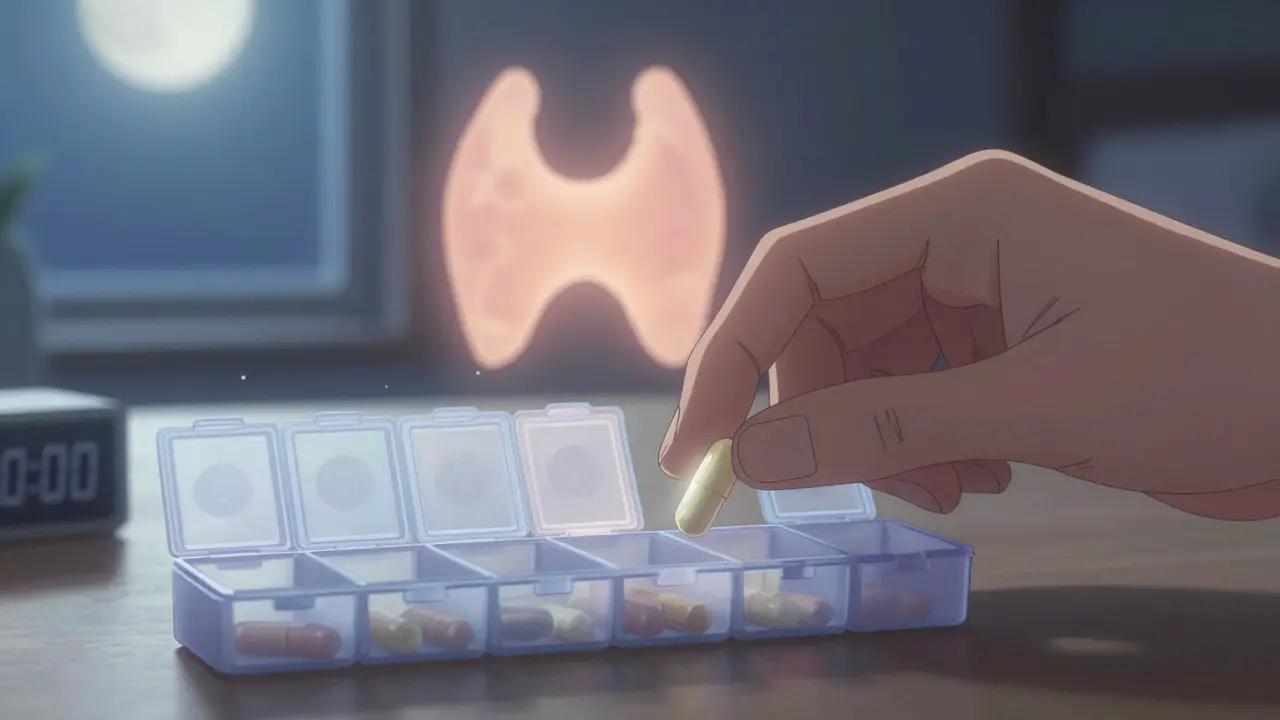
Real-Life Challenges and How to Beat Them
Many patients struggle with the 4-hour rule. One woman on EndoForum wrote: "I take Synthroid at 6 a.m. My calcium is with dinner at 7 p.m. That’s only a 13-hour gap. I’m supposed to wait 4 hours after the pill? That means I can’t take calcium until 10 a.m.-but I’m at work and can’t swallow pills midday."Here’s how real people solve this:
- Use phone alarms. Set two: one for your thyroid med, one for your supplement. 78% of endocrinologists recommend this.
- Use a pill organizer with time slots. Get one with morning, midday, evening, and night compartments. Label them clearly.
- Take calcium at night. If you take levothyroxine in the morning, take calcium after dinner. That’s usually more than 4 hours later.
- Take iron at lunch. If you take levothyroxine at 7 a.m., take iron at 1 p.m. or later.
- Check your multivitamin. Many contain iron or calcium. If yours does, either switch to a thyroid-friendly version (iron-free, calcium-free) or take it at night.
One patient in a ThyroidUK case study saw her TSH drop from 7.4 to 1.8 mIU/L after switching her calcium to bedtime. Her fatigue vanished. She didn’t change her dose-she just changed her timing.
What About Liquid Levothyroxine?
If you’ve tried everything and still can’t get your levels stable, ask about liquid levothyroxine. Brands like Tirosint are in gelatin capsules filled with liquid. Studies show they absorb better and are less affected by food or supplements.A 2020 study found that when patients took liquid levothyroxine with iron, their TSH levels stayed near normal (1.68 mIU/L), while those on tablets spiked to 8.74 mIU/L. That’s a huge difference. The downside? Liquid forms cost about 35% more than tablets. But if your TSH keeps rising despite perfect timing, it might be worth the investment.

What You Should Avoid
Don’t do these things:- Take calcium or iron at the same time as levothyroxine-even if you're "just a little late."
- Take your thyroid med with food or drinks besides water.
- Assume "natural" iron or calcium supplements are safer. They’re not.
- Stop taking supplements because you’re afraid of interactions. You still need them. Just time them right.
What’s New in 2026?
The FDA approved a new extended-release levothyroxine called Thyropatch ER in early 2023. Early data shows it reduces calcium interference by 28%. It’s not widely available yet, but it’s a sign that manufacturers are finally listening.Also, nanoparticle delivery systems are in Phase II trials. These tiny particles shield the hormone from binding with calcium or iron. In early tests, patients absorbed 92% of their dose even when taking supplements together. That could change everything.
Final Advice
Your thyroid doesn’t care how busy you are. It only cares if it gets the right amount of hormone. The difference between a TSH of 2 and 7 isn’t just a number-it’s your energy, your mood, your heart, your weight.Here’s your simple plan:
- Take levothyroxine first thing in the morning, 30-60 minutes before food, with water.
- Wait 4 hours before taking calcium or multivitamins.
- Wait 2-4 hours before taking iron.
- Set alarms. Use a pill box.
- Check your supplements every 6 months. Are they still safe?
- Get your TSH checked every 6-12 weeks after changing your routine.
If you’ve been struggling with fatigue, weight gain, or brain fog despite taking your med-this might be why. You’re not failing. You just need better timing.
Can I take levothyroxine and calcium at the same time if I chew the calcium?
No. Chewing calcium doesn’t prevent the interaction. The chemical binding happens in your gut, not your mouth. Whether it’s chewable, tablet, or liquid, calcium still binds to levothyroxine and blocks absorption. Always separate them by at least 4 hours.
What if I forget and take them together? Should I skip my dose?
Don’t skip your levothyroxine. If you accidentally take calcium or iron within an hour of your thyroid med, take your next dose as scheduled. Don’t double up. One accidental overlap won’t ruin your treatment, but doing it regularly will. Use this as a reminder to set alarms.
Can I take iron and calcium together?
Yes, you can take iron and calcium together. They don’t interfere with each other. The problem is only when either is taken with levothyroxine. So if you take your calcium at night and your iron at lunch, that’s fine. Just keep them away from your thyroid med.
Do all brands of levothyroxine interact the same way?
Yes. Whether it’s Synthroid, Levoxyl, Tirosint, or a generic, they all contain the same active ingredient: levothyroxine. The interaction with calcium and iron is the same across all brands. The only difference is how well they absorb-liquid forms absorb better and are less affected.
How do I know if the separation is working?
Ask your doctor for a TSH test 6-8 weeks after you start following the separation rules. If your TSH drops into the normal range (0.5-4.5 mIU/L), you’re on track. If it stays high, you may need a dose adjustment-or you might still be taking supplements too close to your thyroid med. Keep a log of when you take each pill.