Getting the right medication isn’t just about the name on the bottle. One wrong digit in the NDC number can mean giving a patient a completely different drug - or the wrong dose. In 2023, nearly 12% of reported medication errors in U.S. pharmacies traced back to misreading the National Drug Code. That’s not a small mistake. It’s a life-threatening risk. And yet, most people - even some healthcare workers - don’t know how to read it properly.
What Is the NDC Number?
The National Drug Code, or NDC, is a unique 10-digit number printed on every prescription and over-the-counter medicine sold in the United States. It’s not just a barcode or a serial number. It’s a detailed identifier that tells you exactly which company made the drug, what the active ingredient is, how strong it is, what form it comes in (pill, liquid, injection), and how many units are in the package.
The FDA created the NDC system back in 1972 under the Drug Listing Act. Since then, it’s become the backbone of medication safety. Every time a pharmacist fills a prescription, every time a hospital receives a shipment, every time Medicare pays a claim - they all rely on that 10-digit code to make sure the right drug goes to the right person.
The Three Segments of the NDC
Think of the NDC like a phone number broken into three parts: area code, exchange, and line number. Each segment has a specific job.
- Labeler Code (First Segment): This is 4 to 6 digits long and identifies the company that makes or repackages the drug. For example, the labeler code 00002 belongs to Eli Lilly. If you see that number, you know the drug came from them - not Pfizer or Teva.
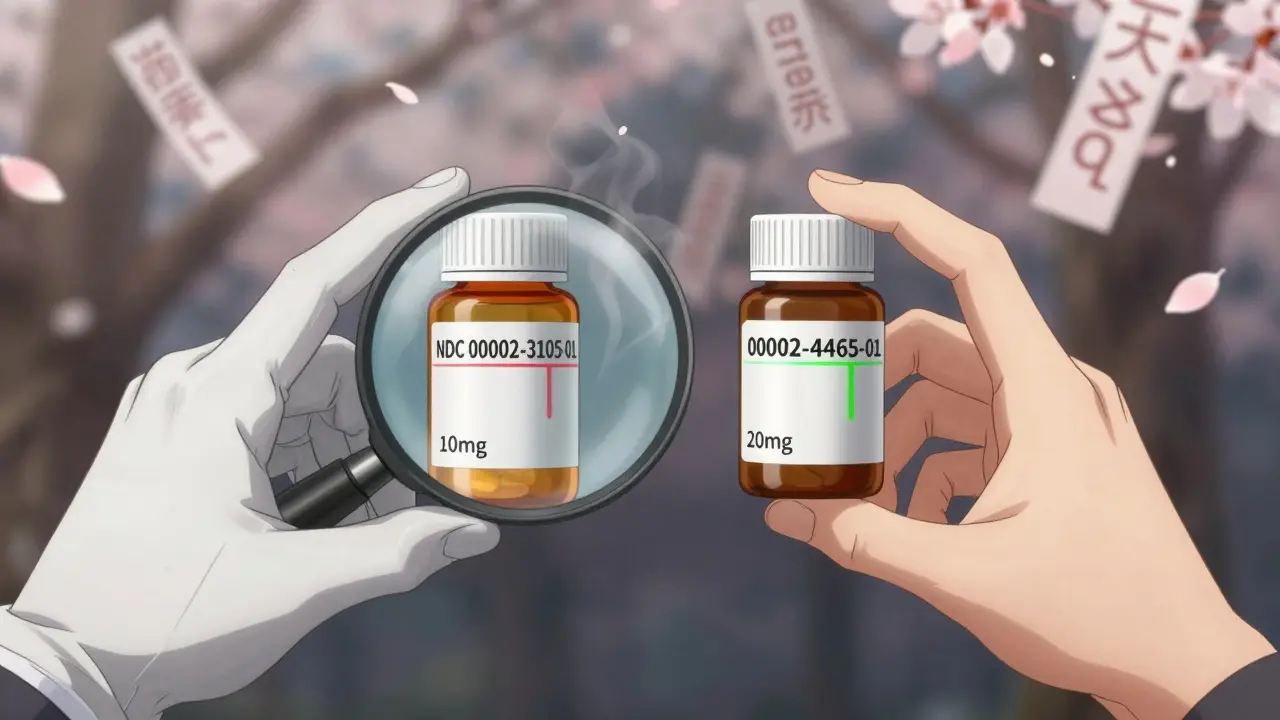
- Product Code (Second Segment): This 3- or 4-digit number tells you the exact drug, strength, and dosage form. It’s the most important part for safety. For instance, the product code 3105 means fluoxetine 10mg capsules. Change that to 4465, and you’re looking at fluoxetine 20mg capsules. Same drug. Twice the dose. Big difference.
- Package Code (Third Segment): This is 1 or 2 digits and tells you the size of the package. 01 might mean a bottle of 30 pills. 02 could mean a bottle of 100. This doesn’t change the drug itself, but it matters for inventory and billing.
These segments are usually written with hyphens, like: 00002-3105-01. But you might also see them without hyphens, or in different formats. That’s where confusion starts.
Three Common NDC Formats
The FDA allows three ways to format the 10-digit NDC:
- 4-4-2 - Example: 1234-5678-90
- 5-3-2 - Example: 12345-678-90
- 5-4-1 - Example: 12345-6789-0
These formats aren’t random. They depend on how many digits the FDA assigned to each labeler. Some companies got shorter codes, so the other segments had to be longer to fit the 10-digit total.
Here’s the catch: insurance companies and Medicare don’t use 10-digit NDCs. They require an 11-digit version in the 5-4-2 format. That means you have to convert it.
How to Convert a 10-Digit NDC to 11-Digit Billing Format
This step trips up even experienced staff. The key is to add a zero where the segment is too short - but only in the labeler or product code, never the package code.
Let’s say you have this NDC: 1234-5678-90 (4-4-2 format).
- Labeler: 1234 → needs to be 5 digits → add a zero at the front → 01234
- Product: 5678 → already 4 digits → leave it
- Package: 90 → already 2 digits → leave it
Result: 01234-5678-90 (5-4-2 format)
Another example: 12345-678-90 (5-3-2 format)
- Labeler: 12345 → already 5 → leave it
- Product: 678 → needs to be 4 digits → add a zero → 0678
- Package: 90 → leave it
Result: 12345-0678-90
Always double-check this conversion. A single missing zero can cause a claim to be denied - or worse, lead to the wrong medication being dispensed.
How to Verify the NDC Against the Prescription
Don’t just read the number. Match it to what’s on the prescription. Here’s your step-by-step check:
- Find the NDC on the packaging. It’s usually printed near the barcode, on the side of the bottle, or on the box. Look for the hyphenated number.
- Identify the format. Count the digits between the hyphens. Is it 4-4-2? 5-3-2? 5-4-1?
- Check the labeler code. Does it match the manufacturer listed on the prescription? If the script says "Lilly" but the NDC is from Teva, pause.
- Match the product code. This is the make-or-break part. Does the product code match the drug name, strength, and form? If the script says "20mg tablet" and the NDC product code is for a 10mg capsule - stop. This is where most errors happen.
- Confirm the package code. Is the quantity right? If the script asks for 90 pills and the NDC is for a 30-pill bottle, you might need to dispense three bottles. That’s fine - but make sure you’re not accidentally giving a 100-pill bottle instead.
- Verify with the FDA NDC Directory. Go to the FDA’s website and search the 10-digit NDC. It will show you the official drug name, strength, manufacturer, and status. Is it active? Or was it discontinued last month?
Pro tip: Say the NDC out loud during double-checks. "Zero-zero-zero-zero-two, three-one-oh-five, zero-one." Hearing it helps your brain catch mismatches your eyes miss.
Why This Matters: Real-World Errors
In November 2023, a pharmacist in Texas caught a near-miss when the NDC for Prozac 20mg capsules (00002-4465-01) was almost dispensed instead of the prescribed 10mg (00002-3105-01). The product code difference was subtle - just one digit. But the dose was doubled. That could have caused serotonin syndrome, seizures, or worse.
Another case: a hospital technician in Florida spent 20 minutes trying to convert a 5-4-1 format NDC to 5-4-2 because the system kept rejecting it. The package code was a single digit - 1 - and he didn’t realize he needed to add a zero to the product code, not the package. He wasted time, delayed care, and nearly gave the wrong drug.
According to a 2023 survey of 1,200 pharmacists, 63% had at least one NDC-related confusion incident every month. The most common mistake? Mixing up the product code with the package code. That’s why the American Society of Health-System Pharmacists now requires NDC verification at three points: when receiving inventory, when preparing the dose, and right before giving it to the patient.
Tools and Resources to Help
You don’t have to memorize every code. There are free tools:
- FDA’s NDC Directory - Free, updated daily. Search by NDC, drug name, or manufacturer. It’s the gold standard.
- FDA NDC Mobile App - Available on iOS and Android. Scan a barcode or type the number. Instant verification.
- Reed Tech’s NDC Converter - Free online tool that converts 10-digit to 11-digit format automatically.
- ASHP Best Practices Guide - Recommends using the FDA app and verbalizing NDC segments during double-checks.
Some pharmacies use paid systems like AAPC Codify or Surescripts, which integrate NDC verification into their electronic prescribing systems. But even if you’re using paper scripts, the FDA’s free tools are enough to prevent errors.
What’s Changing in 2025?
The FDA plans to phase out the current 10-digit formats by 2025 and switch to a single 12-digit NDC standard. This will remove all the confusion around 4-4-2, 5-3-2, and 5-4-1 formats. Every NDC will be 12 digits, with the labeler code expanded to 6 digits, product code to 4, and package code to 2.
Why? Because 8.7% of pharmacy claims are rejected today due to NDC format errors. That’s over 1.2 million errors per year - many preventable.
For now, you still need to know the old system. But if you’re training new staff, start teaching the 12-digit format early. It’s coming.
Final Checklist for NDC Verification
Before you hand over any medication, run through this:
- ✅ Is the NDC visible and legible on the package?
- ✅ Have you identified the format (4-4-2, 5-3-2, or 5-4-1)?
- ✅ Have you converted it to 5-4-2 for billing if needed?
- ✅ Does the labeler code match the manufacturer on the script?
- ✅ Does the product code match the drug name, strength, and form?
- ✅ Does the package code match the quantity ordered?
- ✅ Have you checked the NDC in the FDA’s directory to confirm it’s active?
- ✅ Did you verbalize the full NDC during double-check?
That’s it. Eight steps. Less than a minute. But it could save a life.
Can two different drugs have the same NDC number?
No. Each NDC is unique to one specific drug product - manufacturer, strength, dosage form, and package size. If two drugs have the same NDC, one is counterfeit or mislabeled. Always verify with the FDA’s NDC Directory if you see duplicate codes.
What if the NDC on the bottle doesn’t match the prescription?
Stop. Do not dispense. Contact the prescriber immediately. The most common reasons are: the pharmacy switched manufacturers, the prescription was written for a discontinued product, or there was a transcription error. Never guess. Always confirm.
Do generic drugs have different NDCs than brand-name drugs?
Yes. Even if the active ingredient is identical, the manufacturer is different, so the labeler code changes. For example, generic lisinopril made by Teva has a different NDC than lisinopril made by Mylan. Always verify the product code to ensure strength and form match - not just the drug name.
Is the NDC the same as the barcode?
The barcode usually contains the NDC, but it’s not always the same format. Some barcodes use 11-digit billing format, others use 10-digit label format. Always read the printed NDC number - not just scan the barcode - especially if the system flags a mismatch.
Can I rely on the pharmacy’s computer system to catch NDC errors?
No. Computer systems can have outdated databases, format conversion errors, or miss discontinued codes. A 2022 study found that 23% of NDC errors were not flagged by electronic systems. Human verification is still required - especially for high-alert medications like insulin, blood thinners, or opioids.
What should I do if I can’t find the NDC on the packaging?
Don’t dispense. Contact the supplier or manufacturer. Some small repackagers or international products may not have an NDC - those are not legally allowed for sale in the U.S. without one. If it’s a new medication, check the FDA’s NDC Directory for recent listings. If it’s not there, it may not be approved.


