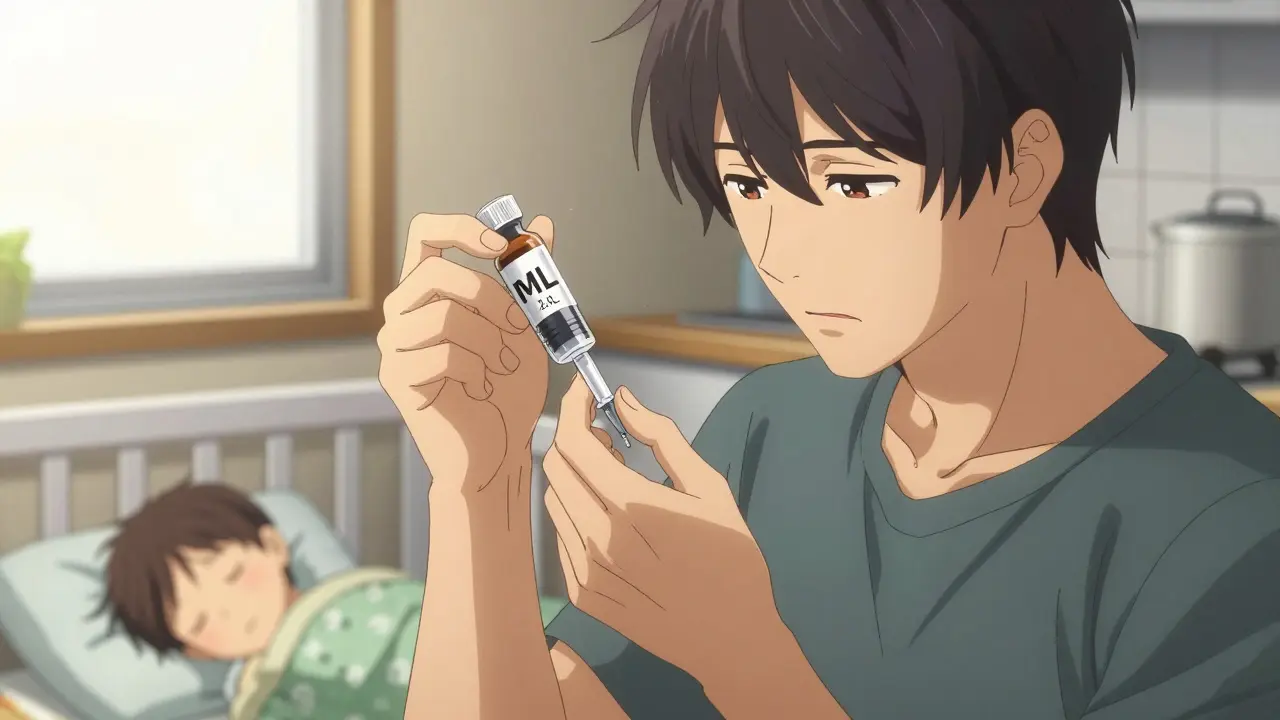
Getting the right dose of medicine for your child isn’t just important-it can be life-saving. Too little and the infection won’t clear. Too much, and you could send them to the emergency room. The worst part? Most parents get it wrong. Studies show about 7 in 10 families make mistakes when measuring liquid medicine at home. And it’s not because they’re careless-it’s because the system is confusing.
Why Milliliters (mL) Are the Only Measurement That Matters
Forget teaspoons and tablespoons. Even if your doctor says "1 teaspoon," they probably mean 5 mL. But here’s the problem: a kitchen teaspoon isn’t 5 mL. It’s usually between 3.9 mL and 7.3 mL. That’s a 40% error right there. For a child, that’s the difference between healing and harm.
The CDC, the American Academy of Pediatrics, and the FDA all agree: only use milliliters (mL). No more "tsp," no more "tbsp." All pediatric liquid medications should be labeled and measured in mL only. This isn’t a suggestion-it’s a safety standard. In 2023, 78% of pediatric liquid meds in the U.S. now follow this rule, up from just 42% in 2015. But many bottles still have both, and that’s where mistakes happen.
Confusing 0.5 mL with 5 mL is a tenfold error. That’s like giving a baby a full adult dose of medicine by accident. It’s happened. And it’s deadly with certain drugs like seizure medications or heart medicines. That’s why every dose must be measured in mL-and only in mL.
Which Tool Should You Use? (And Which Ones to Avoid)
Not all measuring tools are created equal. Here’s what actually works:
- Oral syringes (1-10 mL): The gold standard. They’re accurate, easy to control, and perfect for doses under 5 mL. One study found 94% of parents using syringes got the dose right. For babies and toddlers, this is your only real choice.
- Dosing cups: Okay for older kids who can drink from a cup, but risky for small doses. Error rates jump to 68% when measuring 2.5 mL. They’re harder to read, and kids often spill or spit out the medicine.
- Dosing spoons: Better than kitchen spoons, but still not ideal. Accuracy is around 82%. Only use if no other option is available.
- Kitchen spoons, shot glasses, or eyeballing: Never use these. They vary wildly. A tablespoon can be 10 mL or 20 mL. That’s not a mistake-it’s a danger.
Always use the tool that comes with the medicine. If it didn’t come with one, ask the pharmacist for an oral syringe. Most will give you one for free. If they don’t, buy one. They cost less than $2 online or at any pharmacy.
How to Use an Oral Syringe Correctly
Using a syringe sounds simple, but most people do it wrong. Here’s how to do it right:
- Shake the bottle: Liquid meds like antibiotics settle. If you don’t shake it, the first dose might be too weak, the next too strong. Shake for 10 seconds before every dose.
- Draw up the medicine slowly: Insert the syringe into the bottle. Pull the plunger slowly to the exact line. Don’t rush.
- Hold it up to eye level: Look straight at the line. Don’t tilt your head. The medicine forms a curve (called a meniscus). Read the bottom of that curve.
- Check the number: Is it 2.5 mL? 4 mL? Don’t assume. Read it twice.
- Give it slowly: Gently squirt the medicine into the side of your child’s mouth-between the cheek and gums. Don’t aim for the back of the throat. That triggers gagging. Let them swallow naturally.
- Wash and dry the syringe: Rinse with water after each use. Let it air dry. Don’t store it wet. Mold grows fast.
Pro tip: Mark your syringe with a permanent marker. If your child takes 2.5 mL twice a day, draw a line at 2.5 mL. It saves time and reduces stress.

Weight-Based Dosing: What You Need to Know
Many children’s meds are dosed by weight-not age. That means you need to know your child’s weight in kilograms (kg), not pounds.
Here’s the conversion: 1 kg = 2.2 lb. So if your child weighs 22 pounds, divide by 2.2. That’s 10 kg.
Example: Your child has an ear infection and is prescribed amoxicillin at 40 mg per kg per day, split into two doses. They weigh 10 kg.
- 40 mg × 10 kg = 400 mg total per day
- 400 mg ÷ 2 = 200 mg per dose
Now check the bottle: it says 400 mg per 5 mL. So 200 mg = half of that. Half of 5 mL is 2.5 mL.
That’s your dose: 2.5 mL, twice a day.
If you’re unsure, ask the pharmacist to show you how to calculate it. Write it down. Keep it on your fridge. Don’t rely on memory.
Common Mistakes and How to Avoid Them
Here are the top mistakes parents make-and how to fix them:
- Mistake: Using a kitchen spoon because "it’s close enough." Fix: Keep a labeled oral syringe in your medicine cabinet. Never let kitchen utensils near medicine.
- Mistake: Giving the dose in the front of the mouth. Fix: Aim for the cheek pouch. It’s less likely to trigger gagging or spitting.
- Mistake: Not shaking the bottle. Fix: Shake for 10 seconds every time. Set a phone reminder if you need to.
- Mistake: Assuming the label says mL but it actually says tsp. Fix: Always double-check. If it says "1 tsp," ask the pharmacist to re-label it in mL.
- Mistake: Letting multiple caregivers use different tools. Fix: Give each caregiver the same syringe. Put a sticky note on the bottle with the dose written in big letters.
One mom in Durban told me she used a teaspoon for her daughter’s antibiotics for three days-until the child got worse. The pharmacist found out the dose was only 1.5 mL. She’d been giving 7 mL. That’s nearly five times too much. Her daughter was fine after a hospital visit, but it was a scare she’ll never forget.
What to Do If You’re Still Confused
It’s okay to ask. You’re not alone. Nearly half of all parents feel unsure about dosing at least once.
- Call your pharmacist. They’re trained to explain this stuff. No judgment.
- Ask for a dosing chart. Many hospitals give out free ones with your child’s weight and corresponding doses.
- Use a trusted app. The CDC’s MedSafety app uses augmented reality to show you how to fill the syringe correctly. It reduced errors by over 50% in trials.
- If you’re not a native English speaker, ask for instructions in your language. Pharmacies are required to provide them.
Don’t guess. Don’t assume. Don’t rely on memory. Write it down. Show your partner. Take a picture of the label with your phone.
What’s Changing in 2026?
Good news: things are getting safer. By 2026, the FDA plans to require every pediatric liquid medicine to come with a standard oral syringe labeled only in mL. Hospitals are already giving them out at discharge. Color-coded syringes (like NurtureShot) are becoming common-they change color when you’ve drawn the right dose.
Smart dosing cups with built-in sensors are coming in 2025. They’ll beep if you’ve poured too much. But for now, the simplest tool-the oral syringe-is still the most reliable.
And here’s the real win: if every family used an oral syringe and measured in mL, over 65,000 emergency visits each year could be avoided in the U.S. alone. That’s not just data-it’s kids going to school, not the hospital.
Final Checklist: Before You Give the Dose
- ✅ Is the dose written in mL? (Not tsp or tbsp)
- ✅ Did you shake the bottle for 10 seconds?
- ✅ Are you using the syringe that came with the medicine-or a new one from the pharmacy?
- ✅ Did you read the meniscus at eye level?
- ✅ Did you double-check the number?
- ✅ Did you give it in the cheek, not the front of the mouth?
If you answered yes to all six, you’ve done it right. No guesswork. No risk. Just safety.
Can I use a kitchen teaspoon if I don’t have a syringe?
No. Kitchen teaspoons vary in size from 3.9 mL to 7.3 mL, which can lead to under-dosing or overdosing. Always use an oral syringe or dosing cup marked in mL. If you don’t have one, ask your pharmacist for a free syringe.
What if my child spits out the medicine?
Try giving the dose slowly into the cheek pouch, not the front of the mouth. You can also mix it with a small amount of applesauce or juice-just make sure they eat or drink the whole thing. If they spit out more than half, call your doctor before giving another dose.
How do I convert my child’s weight from pounds to kilograms?
Divide the weight in pounds by 2.2. For example, a 22-pound child is 10 kg (22 ÷ 2.2 = 10). Always double-check with your pharmacist if you’re unsure.
Why do some medicine labels still say "teaspoon"?
Some older bottles haven’t been updated yet, even though the FDA and AAP recommend mL-only labeling. If you see "tsp," ask the pharmacist to write the mL equivalent on the label. Never assume 1 tsp = 5 mL unless it’s clearly stated.
Is it safe to use a syringe for multiple medications?
No. Always use a clean syringe for each medication. Even rinsing isn’t enough-residue can mix and cause reactions. Keep a separate syringe for each drug, and label them with tape if needed.


