
When you pick up a prescription at the pharmacy, you might not realize that the price you pay isn’t just set by the drugmaker. It’s the result of a quiet, complex battle - one where buyers like Medicare, insurance companies, and government health agencies use something powerful: generic drug competition. This isn’t about luck or guesswork. It’s a calculated strategy, backed by data, that has cut drug prices by more than 90% in some cases. And right now, this system is being reshaped by new laws, corporate tactics, and global experiments.
How Generic Drugs Drive Prices Down
Generic drugs aren’t just cheaper versions of brand-name drugs. They’re legally identical in active ingredients, dosage, and effectiveness. But their impact on price? Massive. When just two or three generic manufacturers enter the market, prices begin to drop. With six competitors, the median price falls by 90.1%. With nine, it crashes to 97.3%. That’s not theory - it’s what the FDA found in real-world data from 2018 to 2020.
Take a drug like metformin, used by millions for Type 2 diabetes. Over 100 companies make it. You can buy a 30-day supply for under $5. Compare that to a brand-name drug with no generics - those can cost hundreds. The difference isn’t because one is better. It’s because competition forces prices down. Each new generic manufacturer doesn’t just add supply. It pressures everyone else to lower prices to stay in the game.
The Power of Therapeutic Alternatives
Medicare doesn’t negotiate prices in a vacuum. Its approach, shaped by the 2022 Inflation Reduction Act, uses something called therapeutic alternatives. That means if you’re negotiating the price of a brand-name drug, you look at what similar drugs cost - especially the generic ones.
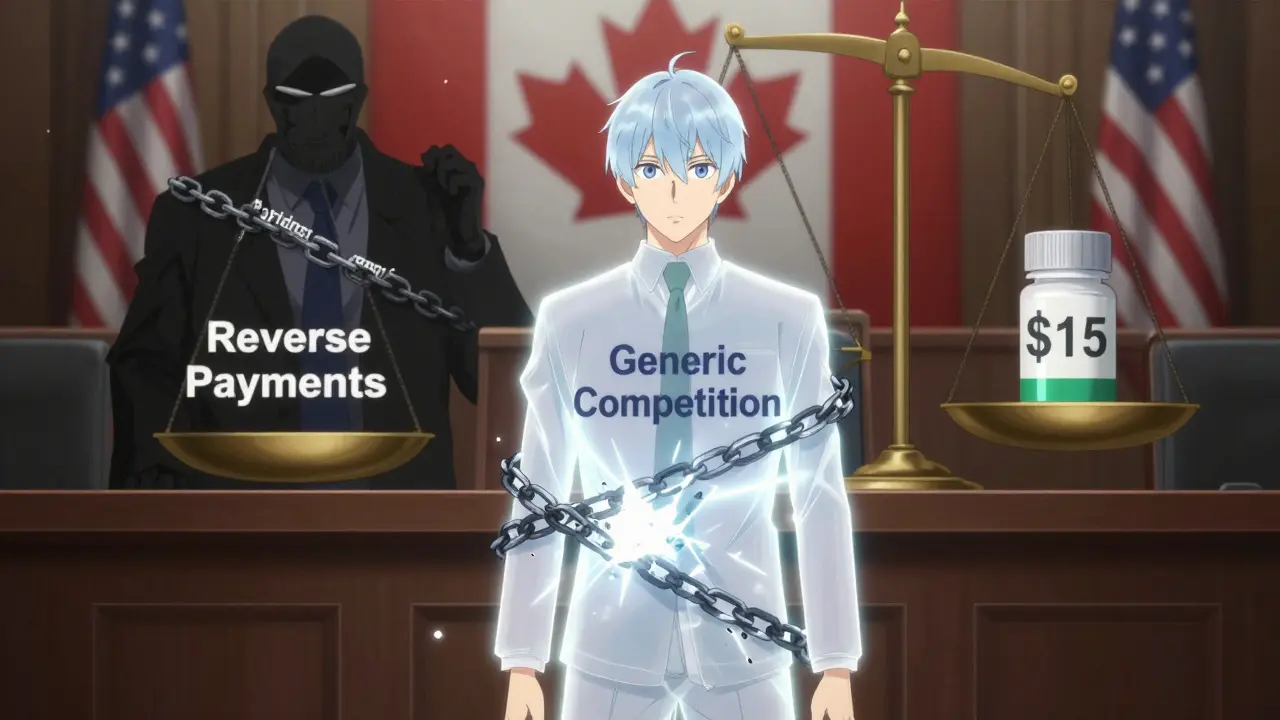
For example, if a new diabetes drug is being considered for negotiation, CMS (Centers for Medicare & Medicaid Services) looks at the average price of all other drugs in the same class - including generics. If the cheapest generic in that class sells for $15 a month, the brand-name drug can’t reasonably be priced at $300. That $15 becomes the starting point. Then, CMS adjusts based on clinical evidence. Is the brand drug significantly more effective? Maybe it gets a small bump. If not? The price drops to match the competition.
This is smart. It doesn’t ban brand-name drugs. It just says: if you’re not offering anything better, you shouldn’t charge more than what’s already available.
Canada’s Tiered Pricing Model
Not every country uses the same method. Canada’s system, updated in 2014, is one of the most clever. Instead of setting a single price, they use a tiered model. The more generic competitors a drug has, the lower the maximum price allowed.
Let’s say a drug has no generics. The government allows a high price to help the brand company recoup R&D. But as soon as one generic enters, the max price drops by 20%. Two generics? Another 15% off. By the time five generics are on the market, the price is less than half of what it was. This gives manufacturers a clear signal: the faster you enter, the more you save. And it keeps prices low even when competition is still growing.
It’s not perfect - some manufacturers delay entry to keep prices high longer. But overall, it’s a system that rewards competition, not monopoly.
How Big Players Are Fighting Back
Brand-name drug companies aren’t sitting still. They’ve developed a whole toolkit to delay generic entry and protect profits.
One tactic? Product hopping. This happens when a company slightly changes a drug - say, switching from a pill to a capsule - and then markets the new version as "improved." They stop making the old version. Patients and doctors are pushed toward the new one, and generics can’t copy it until the patent on the new version expires. Between 2015 and 2020, there were over 1,200 of these maneuvers, according to the FTC.
Another? Reverse payments. A brand-name company pays a generic manufacturer to stay out of the market. It sounds illegal - and in many cases, it is. But it’s happened with over 100 drugs between 2010 and 2020. The brand pays the generic millions to delay its cheaper version. The result? Patients pay more for longer.
These tactics aren’t just shady. They’re expensive. The Congressional Budget Office estimates they add billions to U.S. healthcare costs every year.
Why Generic Competition Is Under Threat
Here’s the paradox: the very system meant to lower prices might be weakening itself.
The Inflation Reduction Act lets Medicare negotiate prices for some brand-name drugs - but only if there’s no generic on the market yet. That sounds fair. But here’s the catch: if Medicare sets a low price before generics even enter, generic manufacturers may decide it’s not worth the risk. Why spend millions on legal battles and manufacturing if the government has already set the price so low that you can’t make a profit?
That’s what Avalere Health found in 2023. If government prices are set too early, it creates a "chilling effect" - generics stay away. That means less competition, and eventually, prices don’t fall as much as they should.
Some experts, like MIT’s Jonathan Gruber, warn this could backfire. The goal is to lower prices. But if fewer generics enter, the long-term savings vanish. The solution? Wait. Let the market do its job first. Let generics compete. Then, if prices are still too high, step in.
Who Wins and Who Loses
Let’s break it down:
- Patients: Win big when generics flood the market. A 90% price drop means more people can afford their meds.
- Medicare and insurers: Win because they pay less. The first 10 drugs negotiated under the IRA could save $6.8 billion a year.
- Generic manufacturers: Win when competition is fair. But lose when brand companies use reverse payments or product hopping.
- Brand-name companies: Lose short-term profits. But argue they lose innovation incentives - though data shows most R&D goes into blockbuster drugs, not generics.
The Association for Affordable Medicines says generics have cut drug costs for four decades. That’s not a fluke. It’s the result of real competition.

The Future: More Data, More Complexity
The next frontier isn’t just about pills. It’s about complex generics and biosimilars. These aren’t simple copies. They’re biologic drugs - made from living cells. They’re harder to produce, harder to copy, and cost far more to develop.
Right now, biosimilars only hold 45% of their market share, compared to 90% for regular generics. Why? High barriers to entry. Manufacturing costs. Regulatory hurdles. And brand companies still use the same tricks - patent thickets, litigation delays - to block them.
But change is coming. By 2025, 73% of health agencies plan to use real-world data - like how well a drug works in actual patients - to guide price negotiations. That means prices won’t just be based on what’s on the shelf. They’ll be based on what actually helps people.
And as countries like the UK update their pricing rules to track European competitors, the pressure to align prices globally will grow. That’s good for buyers. It means less room for price arbitrage.
What Buyers Need to Succeed
Using generic competition to negotiate prices isn’t easy. It takes:
- Access to real-time pricing data - like CMS’s Average Manufacturer Price (AMP) and Prescription Drug Event (PDE) records.
- Staff trained in pharmaceutical economics - 85% of large payers need specialists to make sense of the numbers.
- Transparency. Many pharmacy benefit managers (PBMs) still use secret algorithms. That makes fair negotiation impossible.
Canada’s system works because it’s clear. The rules are public. The thresholds are known. Companies can plan. The U.S. is catching up - but only if CMS sticks to its June 2023 guidance and avoids rushing into price talks before generics have a real chance to enter.
The Bottom Line
Generic drug competition is the most powerful tool we have to lower prescription costs. It’s not perfect. It’s under attack. And it’s being misused by both sides - brand companies delaying entry, and governments setting prices too early.
But the data is clear: more competitors = lower prices. Every new generic manufacturer doesn’t just add supply. It forces everyone else to lower their price. That’s how markets work. And when buyers - whether it’s Medicare, a state health plan, or a private insurer - use that truth as their leverage, patients win.
The real question isn’t whether to use generic competition. It’s whether we’ll let it work - or let corporate tactics and rushed policies break it.
How much do generic drugs actually save compared to brand-name drugs?
Generic drugs typically cost 80% to 85% less than their brand-name equivalents. When multiple generics enter the market, prices drop even further. For example, drugs with six generic competitors see median price reductions of 90.1%, and those with nine competitors drop by 97.3%. According to IQVIA, generics make up 90% of U.S. prescription volumes but only 22% of total drug spending.
Why don’t all drugs have generic versions?
Brand-name drugs are protected by patents that last 20 years from the date of filing. Even after the patent expires, manufacturers often use tactics like "product hopping" - changing the drug’s form slightly - to delay generics. Legal challenges, reverse payments (where brand companies pay generics to delay entry), and complex manufacturing requirements for biosimilars also block competition.
Does Medicare negotiate prices for generic drugs?
No, Medicare does not directly negotiate prices for drugs that already have generic competitors. The Inflation Reduction Act prohibits direct negotiation for drugs with existing generics. But Medicare can use the prices of generic alternatives as a benchmark to set lower starting prices for brand-name drugs during negotiations. This indirect leverage is key to how the program works.
What’s the difference between a generic drug and a biosimilar?
Generic drugs are exact copies of small-molecule drugs made from chemicals. Biosimilars are highly similar versions of complex biologic drugs made from living cells - like proteins or antibodies. Biosimilars are harder to produce, require more testing, and cost more to develop. As a result, they have lower market penetration - only about 45% compared to 90% for traditional generics.
Can government price-setting hurt generic competition?
Yes, if done too early. If Medicare sets a low price for a brand-name drug before any generics enter the market, it can discourage generic manufacturers from investing in the costly process of challenging patents or building production lines. They may decide they can’t make a profit against both the brand and the government-set price. This "chilling effect" can reduce competition and ultimately hurt long-term savings.
Which countries have the most effective generic drug pricing systems?
Canada’s tiered pricing system, which lowers maximum prices as more generics enter, is widely seen as effective. Germany and the UK also use reference pricing - comparing prices across countries - to keep costs down. The U.S. has the highest generic market share (90%), but its negotiation system is newer and still evolving. Countries with predictable, transparent pricing rules tend to see faster generic entry and deeper price cuts.


