
Beers Criteria Medication Safety Checker
Check Medication Safety
Enter a medication name to see if it's on the Beers Criteria list of drugs that may be inappropriate for older adults.
When you’re older, your body doesn’t handle medications the same way it did when you were younger. That’s not just a guess-it’s science. Age changes how drugs are absorbed, broken down, and cleared from your system, and it also changes how your brain and organs respond to them. The result? Older adults are far more likely to suffer serious side effects, even when taking the same dose as someone half their age.
Why Older Bodies React Differently
Your body changes as you age, and those changes directly affect how medications work. Around age 65, the way your body processes drugs begins to shift in noticeable ways. For starters, your total body water drops by about 15% between ages 25 and 80. At the same time, body fat increases-from roughly 25% to 40% in men, and 35% to 48% in women. This means drugs that dissolve in fat, like some antidepressants or benzodiazepines, stick around longer in older bodies. Meanwhile, water-soluble drugs, like digoxin or lithium, become more concentrated because there’s less fluid to dilute them.
Your kidneys also slow down. After age 40, your glomerular filtration rate (GFR)-the measure of how well your kidneys filter waste-drops by about 0.8 mL/min per year. By the time you’re 75, your kidneys may be working at half the speed they did in your 30s. That’s a big deal for drugs like antibiotics, blood pressure meds, or painkillers that your kidneys clear out. If those drugs aren’t adjusted, they build up to dangerous levels.
Your liver, too, becomes less efficient. Blood flow to the liver drops by 20-40% between ages 25 and 65. That means drugs like propranolol or verapamil, which are broken down by the liver, stay in your system longer. And because older adults often have lower levels of albumin-a protein that binds drugs in the blood-more of the drug becomes "free" and active. Take warfarin, for example. Even a small drop in albumin can double the risk of bleeding because more of the drug is floating around unbound.
How Your Brain and Heart Respond
It’s not just about what your body does to the drug-it’s also about how the drug affects your body. Older adults are far more sensitive to the effects of certain medications. A 1998 study found that diazepam (Valium) causes 50% more sedation and memory problems in older adults at the same blood level as younger people. Your brain just gets more reactive.
That’s why benzodiazepines and sleep aids like zolpidem are so risky. They increase the chance of falls by 2-3 times. In fact, one study found that zolpidem causes 80% more next-day drowsiness in people over 65. And it’s not just sleep meds. Anticholinergics-common in allergy pills, bladder meds, and even some cold remedies-can cause sudden confusion or delirium. A 2023 University of Florida study showed that people over 75 were 4.2 times more likely to experience delirium from these drugs than those under 65.
Your heart changes too. Older adults need nearly 50% more propranolol to get the same heart rate reduction as a younger person. But even then, the risk of low blood pressure and fainting spikes. A 2022 JAMA Internal Medicine study found that 28% of people over 80 on blood pressure meds had dizziness or fainting when standing up-compared to just 9% in people aged 50-65. That’s not just inconvenient. It’s a recipe for hip fractures.
When More Pills = More Danger
It’s not unusual for someone over 65 to be on five or more prescription drugs. The CDC says nearly half of older adults take that many. Add over-the-counter meds, supplements, and herbal products, and you’ve got a cocktail that’s hard to track. This is called polypharmacy-and it’s one of the biggest hidden dangers in geriatric care.
Each extra drug increases the chance of a bad interaction. Take a person on warfarin (a blood thinner), amiodarone (a heart rhythm drug), and an NSAID like ibuprofen. All three can increase bleeding risk. Add in an anticholinergic for overactive bladder, and now you’ve got confusion, dry mouth, constipation, and urinary retention-all at once.
And here’s the kicker: many of these drugs were prescribed years ago, when the patient was younger and the risks were different. But no one ever sat down to ask, "Is this still helping?" That’s where deprescribing comes in. It’s not about stopping all meds-it’s about removing the ones that no longer do more good than harm.
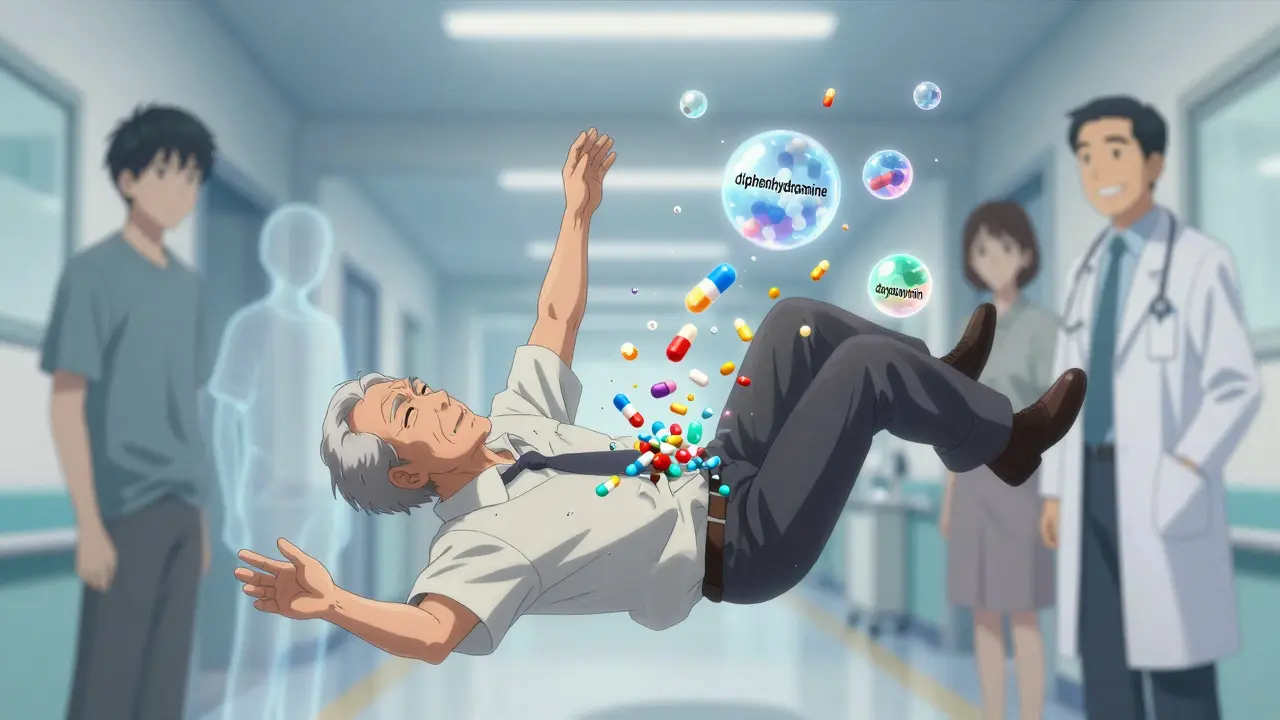
The Beers Criteria and What Doctors Should Avoid
In 1991, the American Geriatrics Society created the Beers Criteria-a list of medications that are too risky for older adults. The latest update in 2023 includes 56 drugs to avoid or use with extreme caution. These aren’t random picks. They’re based on decades of data showing who gets hurt.
Some of the most dangerous include:
- Diphenhydramine (Benadryl): High risk of confusion, falls, and urinary retention.
- Benzodiazepines (Valium, Xanax): High fall and fracture risk. Should be avoided for sleep or anxiety.
- NSAIDs (ibuprofen, naproxen): Increase bleeding, kidney damage, and heart failure risk.
- Anticholinergics (oxybutynin, tolterodine): Linked to dementia and delirium.
- Proton pump inhibitors (omeprazole): Long-term use raises risk of bone fractures and infections.
Doctors who follow these guidelines don’t just avoid these drugs-they actively look for safer alternatives. For example, instead of diphenhydramine for sleep, they might recommend melatonin or behavioral changes. Instead of NSAIDs, they might use acetaminophen (with liver checks) or physical therapy.
Real Stories Behind the Numbers
Behind every statistic is a person. A 78-year-old man in Florida started amitriptyline for nerve pain. Within three days, he couldn’t urinate. He needed a catheter. His doctor had prescribed the standard adult dose-never adjusting for his age or kidney function.
Another woman, 82, was on a blood pressure pill that worked fine for her 50-year-old daughter. But for her, it caused severe drops in blood pressure when standing. She fell, broke her hip, and spent months in rehab. Her doctor had never checked her kidney function or adjusted the dose.
A 2022 survey of over 1,200 seniors found that 68% had experienced dizziness or falls linked to meds. 54% reported memory problems. 41% had unexplained weight loss or gain. And 45% admitted they’d stopped taking a medication because the side effects were worse than the condition.

What Can Be Done?
There are clear, practical steps to reduce harm:
- Start low, go slow. Always begin with 25-50% of the standard adult dose for older adults. Increase slowly.
- Review every 3-6 months. Ask: "Is this still necessary?" "Is there a safer option?" "What happens if we stop it?"
- Do a "Brown Bag Review." Bring all your pills-prescription, OTC, supplements-to your appointment. Pharmacists catch an average of 3.2 errors per patient.
- Check kidney function. Never rely on serum creatinine alone. Use the CKD-EPI formula to calculate eGFR. If it’s below 60, adjust doses.
- Use the STOPP/START criteria. STOPP finds inappropriate meds. START finds ones that are missing (like flu shots, statins, or bone-strengthening drugs).
Technology is helping too. The Beers Criteria app, downloaded over 125,000 times, gives doctors instant guidance at the point of care. AI tools like MedAware reduce medication errors by 42%. And pharmacogenomic testing-checking your genes for how you metabolize drugs-is now cutting adverse reactions by 35% in seniors on psychiatric meds.
The Bigger Picture
Preventable drug reactions in older adults cost the U.S. $30 billion a year. With 16.8% of Americans now over 65-and that number rising fast-the need for smarter prescribing isn’t just medical. It’s economic.
And yet, most clinical trials still exclude people over 75. That means we’re prescribing based on data from people who aren’t like us. The FDA is trying to fix this, aiming for 25% of trial participants to be over 75 by 2026. Until then, doctors must rely on real-world evidence, not just clinical trial data.
What’s next? Precision geriatric medicine. Using genetic data, kidney function, body composition, and drug history to tailor each prescription. The National Academy of Medicine predicts a 50% drop in preventable side effects by 2035-if we act now.
Age doesn’t mean you can’t take meds. But it does mean you need to take them differently. The goal isn’t to avoid treatment-it’s to make sure treatment doesn’t hurt more than it helps.


