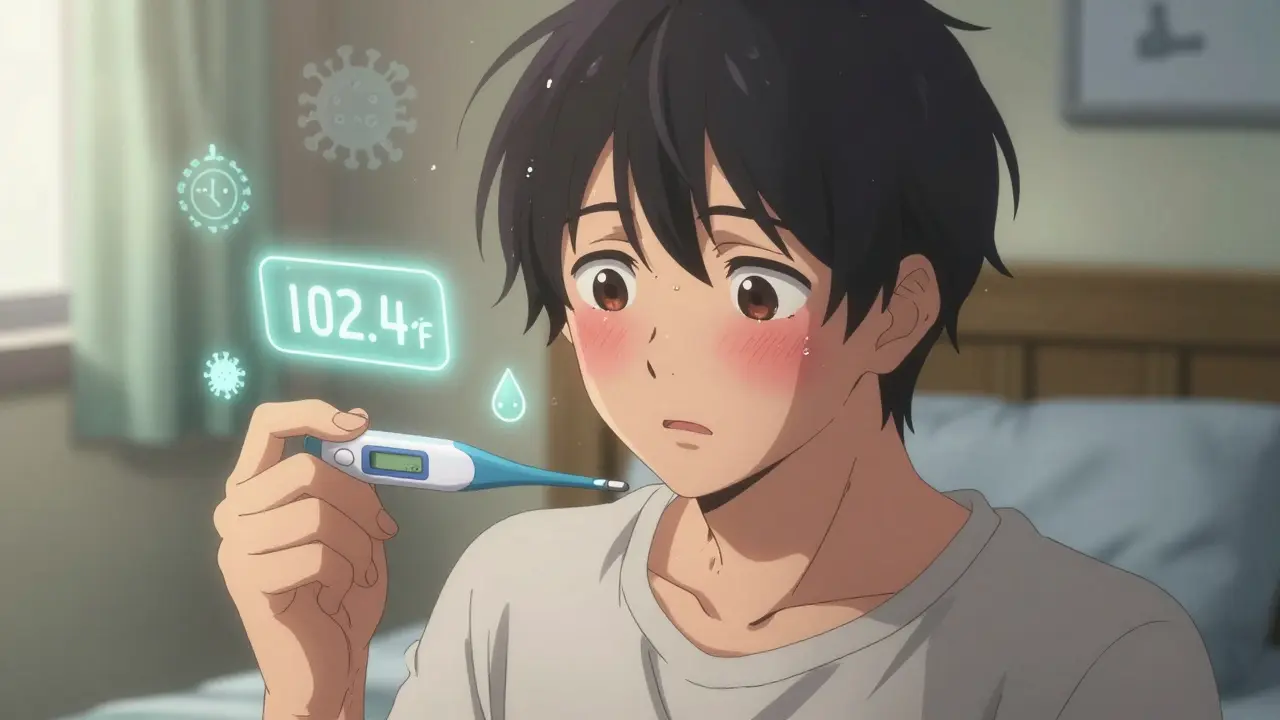
Feeling hot isn’t always just a bad day. A fever is your body’s way of fighting off something-usually an infection. But not all fevers are the same. Some pass in a day. Others can be a warning sign that something serious is happening. The question isn’t just how high your temperature is-it’s how long it lasts, what else you’re feeling, and who you are.
Medically, a fever starts at 100.4°F (38°C). That’s the threshold most doctors use. But here’s the thing: some people naturally run a little warmer or cooler. Your normal might be 97.8°F. If you suddenly hit 100°F, that’s a sign something’s off. Don’t just rely on how you feel. Use a digital oral thermometer. It’s the most accurate for adults. Forehead scanners work too, but they can be off by a degree or two, especially if you just came in from the sun or took a hot shower. Wait 30 minutes, relax, then check again.
Temperature Matters, But Not Alone
Not every fever needs an ER visit. But you need to know the lines.
- Low-grade: 99.1°F to 100.4°F (37.3°C to 38°C) - Often viral, like a cold or mild flu. Usually fine to monitor at home.
- Moderate: 100.6°F to 102.2°F (38.1°C to 39°C) - More likely to be bacterial or a stronger virus. If it lasts more than 48 hours, call your doctor.
- High-grade: 102.4°F to 105.8°F (39.1°C to 41°C) - This is where you stop waiting. At 103°F or higher, especially if it’s not coming down with medicine, you need medical advice.
Harvard Health and Penn Medicine both say: if your fever hits 103°F and sticks around, or keeps climbing, it’s time to get checked. At 105°F (40.6°C), it’s an emergency. Temperatures this high can stress your organs. Your body’s proteins start to break down. That’s not theoretical-it’s biology.
Duration Is the Real Red Flag
Most viral fevers last 48 to 72 hours. That’s it. If yours is still going after three days, even if it’s only 100.8°F, you’re past the point where it’s likely just a virus.
The American College of Physicians found that 90% of viral fevers resolve within 72 hours. That means if it’s still there after that, it’s probably not viral anymore. Bacterial infections-like pneumonia, urinary tract infections, or even sinus infections that turned serious-often show up as fevers that don’t quit. A 2023 study from the Society of Hospital Medicine showed people who waited more than 96 hours before seeking care were more than twice as likely to end up hospitalized.
And don’t ignore recurring fevers. If you get a fever, it goes away for a day, then comes back-over and over for a week-that’s not normal. It could be something like Lyme disease, tuberculosis, or even an abscess hiding somewhere. Your body is trying to tell you something. Listen.

These Symptoms Mean Go Now
Temperature alone doesn’t tell the whole story. Some symptoms that come with fever are non-negotiable. If you have any of these, don’t wait. Don’t call your doctor tomorrow. Go to the ER or call 911.
- Confusion or can’t wake up - Your brain is affected. This could be meningitis or sepsis.
- Stiff neck - Especially with headache or light sensitivity. Meningitis doesn’t always start with a rash. Sometimes, it starts with a stiff neck and fever.
- Difficulty breathing or blue lips/tongue - Your body isn’t getting enough oxygen. This could be pneumonia, COVID-19, or a severe asthma flare.
- Rash that doesn’t fade when you press on it - Think petechiae-tiny red or purple spots. Could be meningococcal disease or toxic shock syndrome. Both can kill in hours.
- Severe pain - Chest pain, abdominal pain, or pain when you pee. These can point to appendicitis, kidney infection, or pelvic inflammatory disease.
- Can’t urinate or walk - Your body is shutting down. This is sepsis territory.
- Seizure - Any fever-related seizure in an adult needs immediate evaluation. It’s rare, but dangerous.
These aren’t "maybe" signs. They’re red flags. And they’re not rare. Emergency departments see them every week. People often think, "I’ll wait and see if it gets worse." But with infections, "worse" can mean irreversible damage.
Special Cases: Who Needs to Be More Careful?
If you’re over 65, or if your immune system is weakened, your rules change.
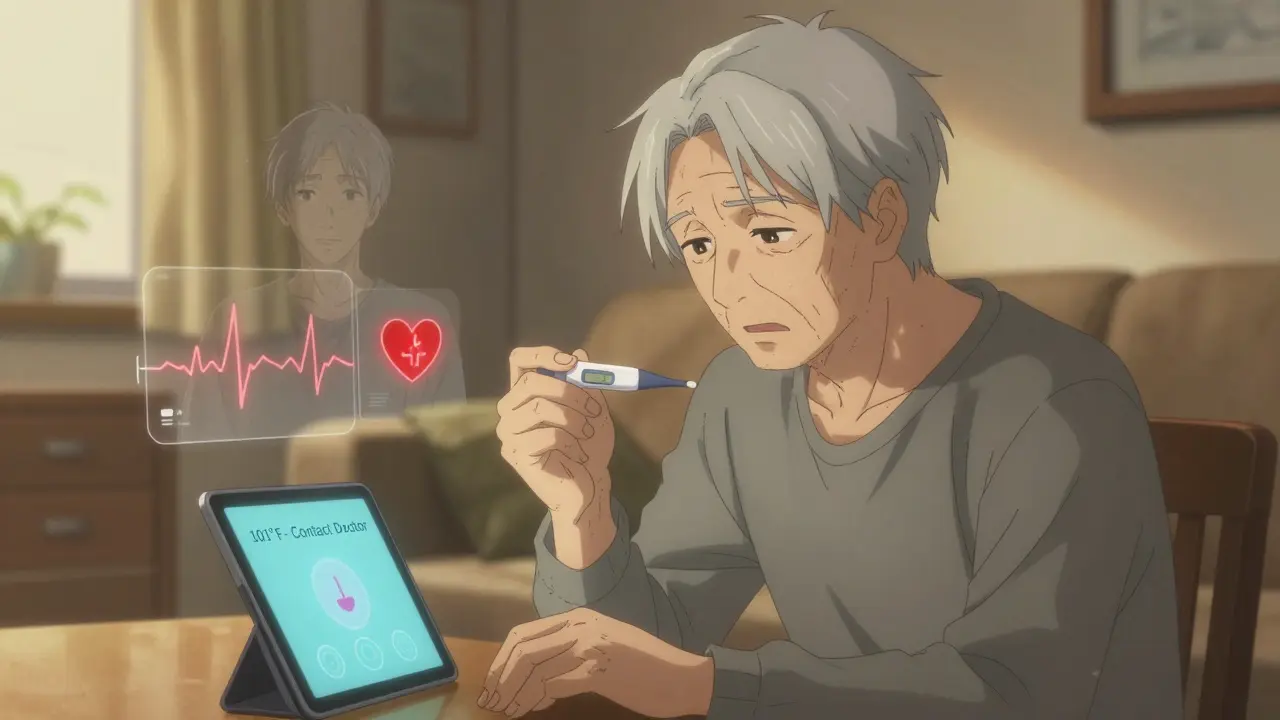
Why? Because your body doesn’t fight back the same way. You might not feel sick until it’s too late. Hackensack Meridian Health and Penn Medicine both say: if you’re immunocompromised-due to chemotherapy, HIV, organ transplant, or long-term steroids-and you hit 101°F (38.3°C), you need to call your doctor today. Same goes for people with chronic conditions: diabetes, heart failure, COPD, sickle cell, or cystic fibrosis.
During the pandemic, we saw this over and over. Older adults with COVID-19 didn’t always spike to 104°F. They just felt tired, confused, or off. That’s why guidelines now say: for high-risk groups, even a low-grade fever is a red flag.
And if you’ve been around someone with the flu or COVID-19 recently? Don’t brush off a mild fever. Get tested. Early treatment can make all the difference.
What to Do Before You Call the Doctor
While you’re deciding whether to go in, here’s what helps:
- Drink water. Fever dehydrates you fast. Sip fluids every 20 minutes.
- Take acetaminophen or ibuprofen if you’re not allergic. Don’t use aspirin-it can be dangerous in adults with certain conditions.
- Rest. Don’t push yourself to work or run errands.
- Take your temperature every 4 hours. Write it down. That helps your doctor see the pattern.
- Watch for new symptoms. A rash? Trouble breathing? Dizziness? Write them down too.
And if you’re unsure? Use telehealth. Services like HMH 24/7 virtual care let you talk to a doctor from home. A 2023 study found that 62% of non-emergency fever cases can be handled remotely. You avoid the ER wait, and you still get expert advice.
Why People Wait Too Long
A Kaiser Permanente survey in 2023 found that 68% of adults misjudge fever severity. Nearly half waited until their temperature hit 104°F before seeking help. That’s too late. Many of them didn’t know about the 103°F rule. Or they thought fever was just "part of being sick."
The truth? Fever is a symptom, not a disease. It’s your body’s alarm. Ignoring the alarm doesn’t make the problem go away-it just gives it more time to grow.
And here’s a hard truth: 30% of adult fever cases that end up in urgent care were delayed past 72 hours. That delay isn’t just about inconvenience. It’s about risk. The longer you wait, the higher your chance of complications-dehydration, organ stress, or even sepsis.
Is a fever of 102°F dangerous for adults?
A fever of 102°F isn’t an emergency, but it’s not normal either. It’s considered moderate-grade and often signals a stronger infection. If it lasts more than 48 hours, doesn’t respond to medication, or comes with other symptoms like headache, fatigue, or body aches, you should contact a healthcare provider. Most viral infections clear within 72 hours, so if yours is still there after three days, it may need treatment.
Can I wait out a fever at home?
Yes-if it’s under 103°F, you’re otherwise healthy, and you’re getting better after 48 hours. Drink fluids, rest, and take over-the-counter fever reducers like acetaminophen or ibuprofen. But if your fever stays high, gets worse, or you develop new symptoms like confusion, rash, or trouble breathing, don’t wait. Go to a clinic or ER.
What’s the best way to take my temperature?
For adults, a digital oral thermometer is the most accurate. Place it under your tongue, close your mouth, and wait until it beeps. Forehead (temporal artery) thermometers are convenient but can be off by 0.5-1°F, especially if you’ve been outside or just exercised. Don’t use armpit or ear thermometers for serious evaluation-they’re too unreliable.
Should I go to the ER if I have a fever and a rash?
Yes-if the rash doesn’t fade when you press on it. That’s called a petechial rash, and it can signal meningococcal disease or toxic shock syndrome, both life-threatening. Even if your fever is only 101°F, get help immediately. Don’t wait for it to get worse. Time matters.
Why is fever worse in older adults?
As we age, our immune system doesn’t respond as strongly. Older adults may not spike a high fever even when they have a serious infection like pneumonia or a UTI. A fever of 101°F or higher in someone over 65 could be the only sign of a major problem. That’s why guidelines recommend medical evaluation at lower temperatures for seniors and those with chronic illnesses.
Can stress or exercise cause a fever?
No-not a true fever. Stress or exercise can raise your body temperature temporarily, but not above 100.4°F in a way that counts as a fever. If your temperature is elevated after exercise, rest for 30 minutes in a cool room and check again. If it stays high, it’s likely due to an infection, not physical activity.
Do I need antibiotics for a fever?
Not always. Most fevers are caused by viruses-like the flu or a cold-and antibiotics won’t help. Antibiotics only work on bacterial infections. Taking them unnecessarily can lead to resistance. Your doctor will decide if you need them based on your symptoms, exam, and sometimes tests like blood work or a throat swab.
If you’re unsure, it’s better to call. Most urgent care centers have telehealth options. You don’t need to wait until you’re barely standing. Your health isn’t something to gamble with. Fever is your body’s alarm-and you should never ignore it.


