Diphenhydramine Overdose Risk Calculator
Calculate Your Risk
Your Risk Assessment
Diphenhydramine dose: mg
Dose per kg: mg/kg
Urgent Medical Attention Needed
If you or someone else has taken more than 20 mg/kg ( mg), call 911 immediately.
Most people think of Benadryl as a harmless sleep aid or allergy pill. It’s in medicine cabinets across the country, sold over the counter, and often taken without a second thought. But when someone takes too much-whether by accident, mistake, or intentional misuse-it can turn deadly. A diphenhydramine overdose isn’t just about feeling sleepy. It can shut down your heart, trigger seizures, cause hallucinations so real you can’t tell what’s real, and even kill you. And it’s happening more often, especially among teens lured by dangerous social media challenges.
What Happens When You Take Too Much Diphenhydramine?
Diphenhydramine works by blocking histamine, which helps with allergies and itching. But it also blocks another key chemical in your brain and body: acetylcholine. That’s why it makes you drowsy. At normal doses-25 to 50 mg every 4 to 6 hours-it’s safe. But once you cross 5 mg per kilogram of body weight (about 350 mg for a 150-pound person), things start to go wrong. At 20 mg/kg or more, you’re in life-threatening territory.
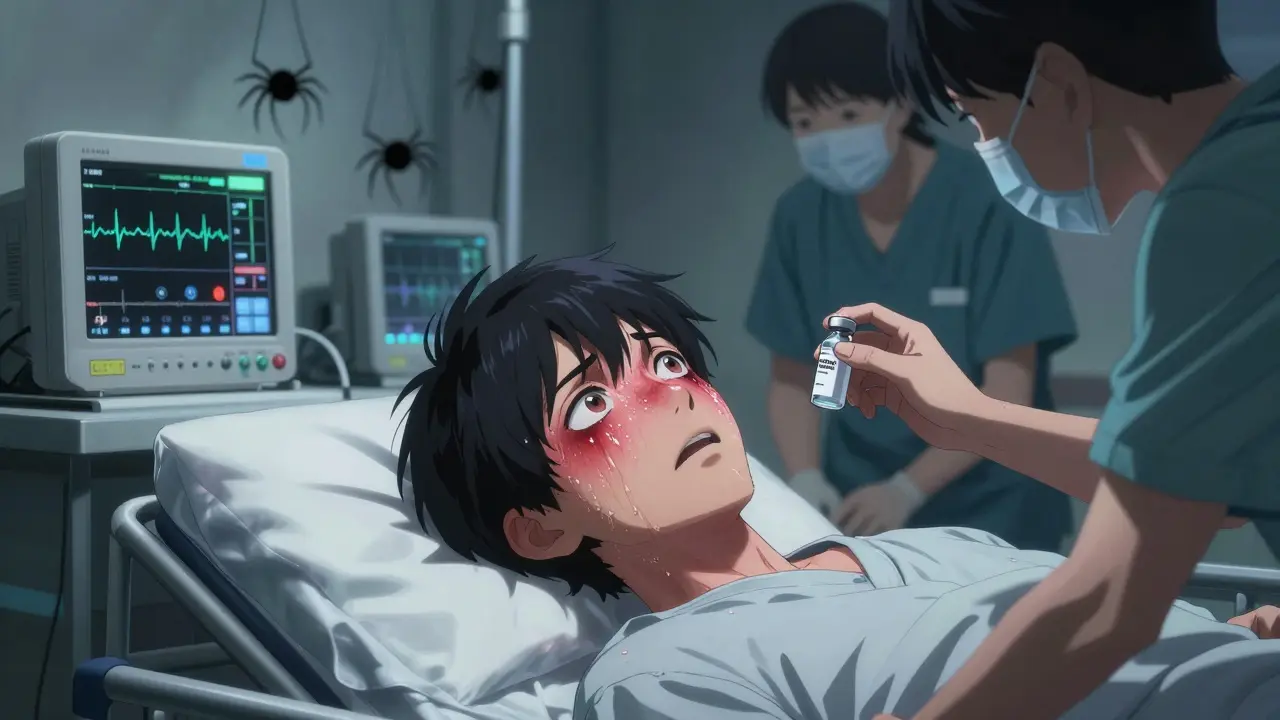
The body reacts with what doctors call an anticholinergic toxidrome. Think of it as a cluster of symptoms that show up together. You’ll hear them described with a memorable rhyme: “Dry as a bone, red as a beet, blind as a bat, mad as a hatter, hot as hades, full as a flask.”
- Dry as a bone: Your mouth feels like sandpaper. You can’t spit. Your eyes are parched.
- Red as a beet: Your skin turns flushed and hot, even if you’re not feverish.
- Blind as a bat: Your pupils are huge, fixed, and don’t react to light. You can’t focus. Everything looks blurry.
- Mad as a hatter: You’re confused. You see things that aren’t there. You hear voices. You might scream, fight, or become completely withdrawn.
- Hot as hades: Your body temperature soars past 104°F (40°C). This isn’t a fever-it’s your brain losing control of temperature regulation.
- Full as a flask: You can’t pee. Your bladder swells. It’s painful. You need a catheter.
These symptoms don’t just make you uncomfortable-they’re warning signs your nervous system is failing.
The Hidden Danger: Your Heart Stops Acting Right
What most people don’t know is that diphenhydramine doesn’t just mess with your brain. It also messes with your heart-like a tricyclic antidepressant. It blocks sodium channels in heart muscle cells. That’s why, on an EKG, you’ll see something called QRS widening.
Normal QRS duration? Less than 100 milliseconds. When it’s over 100 ms, you’re in danger. Over 120 ms? That’s a red flag for cardiac arrest. QT prolongation is another killer. When the heart’s electrical cycle gets too long, it can twist into a rhythm called torsades de pointes-a type of ventricular tachycardia that can turn fatal in minutes.
Heart rates often spike to 140 beats per minute or higher. Blood pressure drops. You can go from agitated to unconscious in seconds. In severe cases, patients develop rhabdomyolysis-muscle tissue breaks down, floods the bloodstream with toxins, and can shut down your kidneys. Some need dialysis.
And here’s the scary part: these cardiac effects can show up hours after you took the pill. Someone might seem fine at the ER, get sent home, then collapse 3 hours later.
What Do Doctors Do in the Emergency Room?
There’s no antidote you can just swallow. Treatment is all about supporting the body while it clears the poison. But that doesn’t mean doing nothing. Here’s what actually works:
- Monitor the heart. Continuous EKG. Check QRS width and QTc every hour. If QRS is over 100 ms, give sodium bicarbonate-1 to 2 mEq per kg as a bolus, then an infusion. This pushes sodium back into the heart cells and stabilizes the rhythm.
- Stop the seizures. Benzodiazepines like lorazepam or diazepam are first-line. They calm the brain and prevent further damage.
- Lower the fever. Ice packs, cooling blankets, IV fluids. Hyperthermia above 102.2°F (39°C) can cause brain damage.
- Empty the bladder. Catheterization isn’t optional-it’s lifesaving. A distended bladder can rupture.
- Reverse the delirium. This is where things get interesting. For years, doctors avoided physostigmine because they thought it was too risky. But new data shows it’s safe and far more effective than sedatives alone. In one study, 87% of patients with severe confusion improved with physostigmine. Only 24% did with benzodiazepines. It’s given as a slow IV push-0.5 to 2 mg-and works in minutes. The catch? Don’t use it if the person has heart block, seizures, or a widened QRS. That’s when benzodiazepines stay the go-to.
And yes-there are extreme cases. If someone’s in cardiac arrest and standard CPR isn’t working, doctors have used IV lipid emulsion (like a fat solution) to pull the drug out of the bloodstream. ECMO-machine-assisted heart-lung support-has saved lives when everything else failed.
Why Are Teens Dying From Benadryl?
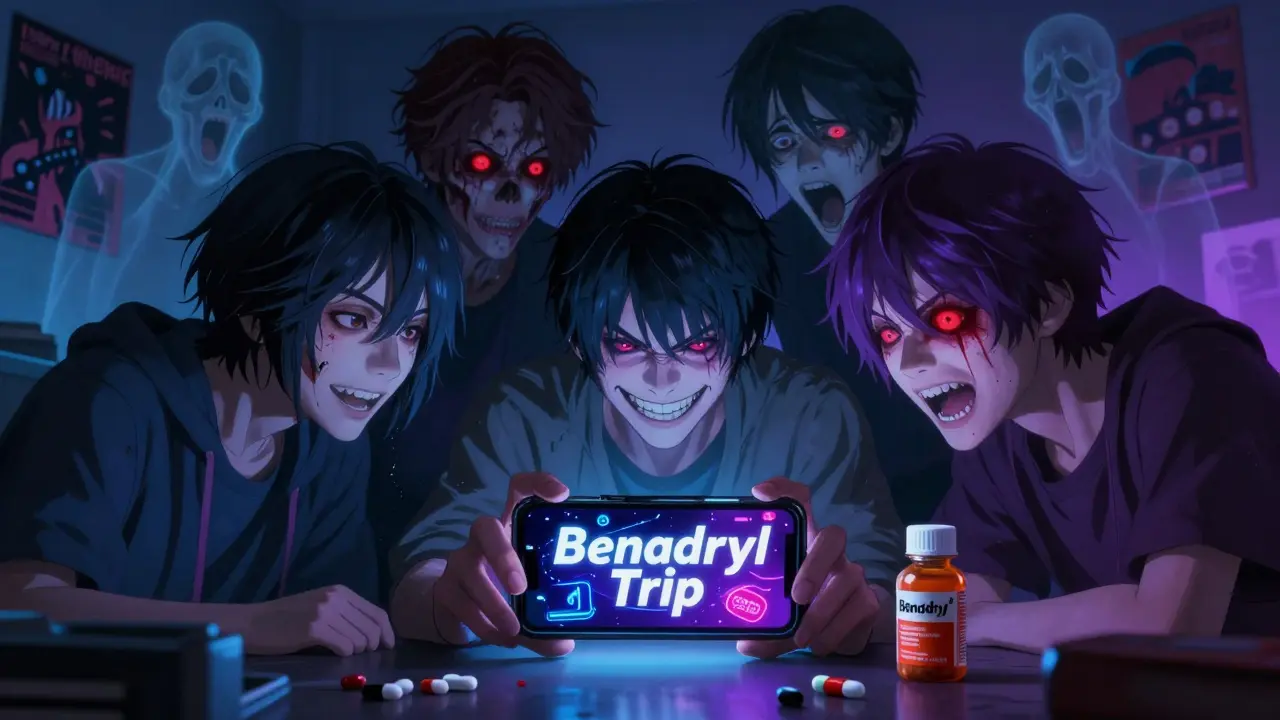
In 2022, poison control centers in the U.S. saw a 300% jump in intentional diphenhydramine overdoses among 13- to 19-year-olds. Why? Social media.
On TikTok, YouTube, and Reddit, teens are being told that taking 10, 20, even 30 Benadryl pills can give you a “trip.” They call it the “Benadryl Challenge.” One Reddit user wrote: “Took 600 mg thinking I’d get high. Woke up in the ER with a catheter. Couldn’t move. Thought I was dying.”
It’s not a high. It’s a nightmare. Hallucinations of spiders crawling under the skin. Paralysis. Inability to speak. Memory loss that lasts days. Some don’t wake up.
The FDA issued a warning in 2021. The American Academy of Pediatrics launched a campaign: “Don’t Take the Benadryl Challenge.” But the videos keep popping up under new hashtags. Parents don’t know their kids are doing this. Teens don’t realize how fast it can go wrong.
What Should You Do If Someone Overdoses?
If you suspect someone took too much diphenhydramine-whether it’s a child who found the bottle, a teen who tried the challenge, or an adult who misread the label-act immediately.
- Call 911. Don’t wait for symptoms. Don’t assume they’ll “sleep it off.”
- Call Poison Control. In the U.S., it’s 1-800-222-1222. They’ll guide you on what to do while EMS is coming.
- Don’t induce vomiting. It can cause choking or aspiration.
- Bring the bottle. If they took Tylenol PM or another combo product, the acetaminophen can cause liver damage too. The ER needs to know what else is in there.
- Stay with them. Keep them awake if possible. If they’re unconscious, place them on their side to prevent choking.
Even if they seem okay after an hour, don’t assume they’re safe. Cardiac effects can be delayed. Observation for 4 to 6 hours is standard. If they had any heart changes, they need to be monitored overnight.
Recovery Isn’t Always Quick
People who survive diphenhydramine overdose often don’t feel normal for days. Sixty-five percent report lingering drowsiness for 24 to 48 hours. Forty percent have confusion, trouble concentrating, or memory gaps. Some can’t drive or work for a week.
And the emotional toll? Real. One patient told her doctor: “I thought I was going to die. I saw my dead grandmother in the corner of the room. I screamed for hours. I still have nightmares.”
Recovery isn’t just physical. It’s psychological too.
What’s Changing in Treatment?
Medical toxicologists are updating their guidelines. The big shift? Earlier use of physostigmine for delirium. No more waiting until the person is screaming or violent. If they’re confused, hallucinating, and have no heart block-give physostigmine. It’s faster. It’s safer than we thought. And it saves brain time.
Also, more hospitals are starting to use smartphone apps like Poison Help, which connects users directly to poison control centers. Since its 2021 launch, it’s been downloaded over 150,000 times. That’s a game-changer for rural areas or families who don’t know who to call.
The message is clear: diphenhydramine is not harmless. It’s a powerful drug with a narrow safety margin. What you think is a sleepy pill can be a silent killer.
Can you die from a Benadryl overdose?
Yes. While fatal cases are rare-around 0.5% of severe overdoses-they do happen. Deaths are usually caused by cardiac arrest from QRS widening, seizures, or hyperthermia. Most fatalities occur when people take more than 20 mg per kilogram of body weight-about 1,400 mg for a 150-pound person. Many of these cases involve teens participating in dangerous social media challenges.
How long does it take for diphenhydramine to cause symptoms?
Symptoms usually start within 30 to 60 minutes after ingestion, but can be delayed up to 4 hours. Cardiac effects like QRS widening and arrhythmias often appear 2 to 4 hours after taking the drug, even if the person seems fine. That’s why observation for at least 6 hours is critical-even if symptoms seem to resolve.
Is physostigmine safe to use for diphenhydramine overdose?
Yes, when used correctly. Earlier fears about physostigmine causing seizures or heart problems have been disproven by recent studies. A 2021 analysis showed adverse events occurred in only 4.7% of cases, with no deaths linked to the drug itself. It’s contraindicated only in patients with seizures, heart block, or QRS widening over 100 ms. For those without those issues, it’s the fastest and most effective way to reverse delirium.
Can you test for diphenhydramine levels in the blood?
Technically, yes-but it’s not useful in an emergency. Blood levels don’t reliably predict how sick someone will be. Two people with the same level can have very different symptoms. Doctors don’t wait for lab results. They treat based on symptoms and EKG changes. Testing is only done for legal or forensic reasons, not clinical management.
What should parents do to prevent diphenhydramine overdose in teens?
Talk openly about the dangers. Don’t assume your teen knows it’s risky. Many believe it’s “just an allergy pill.” Lock up medications, especially combination products like Tylenol PM. Monitor social media use and be alert for signs of hallucinations, confusion, or unexplained drowsiness. If you suspect misuse, call Poison Control immediately. Prevention starts with awareness-this isn’t a prank. It’s a medical emergency.


