
For people who suffer from chronic migraine, the pain isn’t just occasional-it’s a constant presence. Fifteen or more headache days a month, with at least eight of them meeting migraine criteria, turns life into a cycle of medication, exhaustion, and missed days. If you’ve tried pills like topiramate or beta-blockers and they didn’t work-or gave you side effects like brain fog, weight loss, or tingling fingers-you’re not alone. That’s where Botox comes in. Not as a cosmetic fix, but as a proven medical treatment backed by over a decade of clinical data and approved by the FDA since 2010.
How Botox Stops Migraines Before They Start
Botox, or onabotulinumtoxinA, is a purified protein from the bacteria Clostridium botulinum. It’s famous for smoothing wrinkles, but its real power in migraine lies in how it interacts with nerves-not muscles. When injected into specific areas of the head and neck, it doesn’t just relax tight muscles. It blocks the release of pain-signaling chemicals like CGRP (calcitonin gene-related peptide), which spikes during a migraine attack. It also interferes with the way nerves communicate pain signals to the brain, reducing both peripheral and central sensitization. Think of it as turning down the volume on your nervous system’s pain alarm.
Unlike triptans or gepants that treat an active migraine, Botox works preventively. It doesn’t stop a headache once it’s started. Instead, it lowers the overall frequency and intensity of attacks over time. Research shows it targets C-fibers in the trigeminal nerve system-the main pain pathway involved in migraines. It also has anti-inflammatory effects, reducing swelling around nerves that can trigger attacks. This multi-pathway action is why it’s so effective for chronic cases.
Who Actually Benefits from Botox for Migraine?
Not everyone with headaches qualifies. Botox is only approved for chronic migraine: 15 or more headache days per month, with at least eight being migraines. If you have fewer than 15 days, studies show it won’t help. That’s a key point. Many people assume Botox works for all migraines-but it doesn’t.
The best candidates are those who’ve tried and failed at least three other preventive treatments. That usually means medications like beta-blockers, antidepressants, or anti-seizure drugs. If those caused side effects like fatigue, memory issues, or nausea, Botox offers a non-pill alternative. It’s especially helpful for people with medication-overuse headache, where frequent use of painkillers actually makes migraines worse.
Real-world data from over 1,200 patients shows that 63% of chronic migraine sufferers saw at least a 50% drop in headache days after one year of treatment. Some saw reductions of 12 or more days per month. Patients with 20+ headache days tend to feel the biggest absolute improvement-even if the percentage drop looks similar across the board. If you’re stuck in a cycle of daily pain and rescue meds, this isn’t just helpful-it’s life-changing.
The Injection Protocol: What to Expect
The treatment follows a strict, science-backed plan called the PREEMPT protocol. It’s not random. A trained specialist gives 31 to 39 tiny injections across seven specific sites: forehead, temples, back of the head, neck, and shoulders. The total dose is 155 to 195 units. Each session takes about 15 minutes. No anesthesia is needed-most people feel a quick pinch.
It’s not a one-time fix. Treatments happen every 12 weeks, year after year. Most people don’t feel the full benefit until their third or fourth round. That’s because it takes time for the nerve signaling to reset. Don’t get discouraged if the first round doesn’t change much. Patience is part of the process.
Side effects are mild for most. The most common are neck pain (about 10% of patients), temporary headache, or slight eyelid drooping (under 4%). Some report muscle weakness in the neck or shoulders, which usually fades within a few weeks. There’s no downtime. You can drive yourself home and return to work the same day.
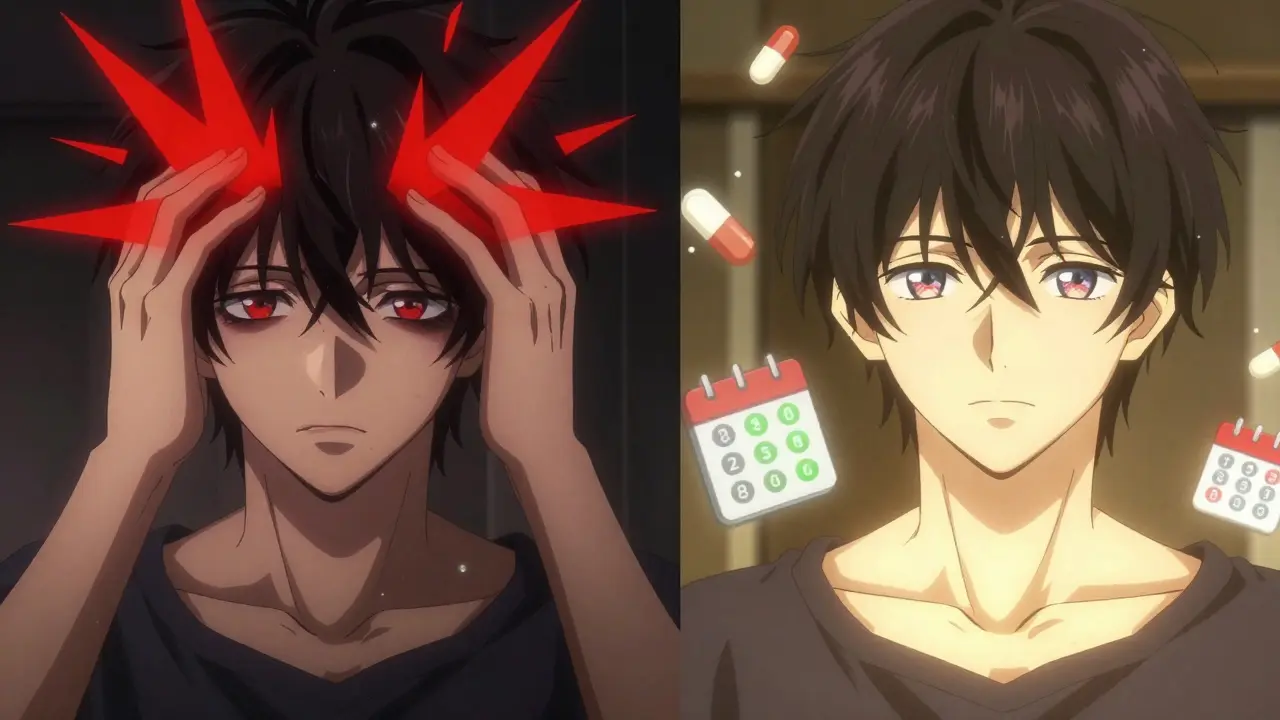
How It Compares to Other Treatments
Let’s say you’re choosing between Botox, topiramate, propranolol, and a newer CGRP antibody like erenumab. Here’s how they stack up:
| Treatment | Resonder Rate (50%+ Reduction) | Common Side Effects | Dosing Frequency | Cost (Annual, Before Insurance) |
|---|---|---|---|---|
| Botox (onabotulinumtoxinA) | 47.2% | Neck pain, headache, eyelid droop | Every 12 weeks | $6,000-$7,200 |
| Topiramate | 38.5% | Brain fog, tingling, weight loss, kidney stones | Daily pill | $500-$1,200 |
| Propranolol | 35.1% | Fatigue, low blood pressure, dizziness | Daily pill | $100-$300 |
| Erenumab (CGRP antibody) | 51.8% | Constipation, injection site reaction | Monthly injection | $7,000-$9,000 |
Botox has a better safety profile than topiramate, which causes people to quit because of side effects nearly one-third of the time. It’s less expensive than CGRP antibodies, though more costly than older pills. The trade-off? You need to go to the doctor every three months. But if you can’t tolerate daily pills or want to avoid long-term drug effects, Botox is a strong middle ground.
Insurance, Cost, and Access
The out-of-pocket cost for one session is $1,500 to $1,800. That adds up to $6,000-$7,200 a year. But most insurance plans cover it-for chronic migraine-if you’ve tried and failed at least three other preventives. You’ll need to keep a headache diary for at least three months and get documentation from your doctor. Some insurers require prior authorization, which can delay treatment. If you’re denied, appeal. Many approvals come after a second review.
Eighty-five percent of major insurers cover Botox for migraine when criteria are met. Still, 43% of dissatisfied patients cite insurance hurdles as their biggest frustration. Talk to your doctor’s office-they often have staff who specialize in navigating these approvals.

Real Stories, Real Results
On patient forums, people describe Botox as a game-changer. One user wrote: “After three rounds, I went from 25 migraine days a month to 8-10. My worst attacks are now moderate, not debilitating.” Another said: “I stopped taking triptans every week. My brain feels clearer.”
But it’s not perfect. Some report inconsistent results between cycles. A few feel temporary weakness in their neck or shoulders, making it hard to hold their head up. Others say the injections hurt more than expected. And while 58% of users report significant improvement, 29% say their results vary too much to rely on.
Patience matters. Sixty-one percent of people don’t see maximum benefit until after their third or fourth treatment. If you quit after one or two rounds, you’re not giving it a fair shot.
The Future of Botox for Migraine
In 2023, the FDA expanded approval to teens aged 12-17 with chronic migraine, based on a trial showing a 7.8-day reduction in headache days. That’s huge for families struggling with pediatric migraine.
Doctors are now testing combinations-pairing Botox with CGRP antibodies. Early results show a 68% responder rate, higher than either treatment alone. That’s promising for patients who don’t respond fully to one option.
Researchers are also working on longer-lasting versions. Early trials suggest a modified formula could last 16 to 20 weeks, cutting annual visits from four to three. That could improve adherence and reduce costs.
What’s clear is that Botox isn’t going away. Even with new drugs entering the market, 78% of patients stay on it for two years or more. That retention rate speaks volumes. It’s not flashy, but it works-reliably, safely, and for a wide group of people who’ve run out of other options.
Is Botox Right for You?
Ask yourself these questions:
- Do I have 15 or more headache days a month, with at least 8 being migraines?
- Have I tried at least three preventive medications and stopped them due to side effects or lack of results?
- Am I willing to commit to quarterly doctor visits for the long term?
- Do I want a treatment that doesn’t involve daily pills or systemic side effects?
If you answered yes to most of these, talk to a headache specialist-not just any doctor. Look for someone board-certified in neurology with specific training in the PREEMPT protocol. Experience matters. Studies show injector skill accounts for up to 30% of outcome differences.
Botox isn’t a cure. But for chronic migraine, it’s one of the few treatments that actually changes the trajectory of the disease. It doesn’t just mask pain-it resets how your nerves respond to it. If you’ve been stuck in a loop of pain and pills, it might be the break you’ve been waiting for.
Can Botox stop a migraine once it starts?
No. Botox is only for prevention. It doesn’t work as a rescue treatment. For active migraines, use medications like triptans, gepants, or anti-nausea drugs. Botox lowers how often attacks happen, but it won’t end one that’s already underway.
How long does it take for Botox to work for migraines?
Most people start noticing changes after the second treatment, around 6 to 8 weeks. Maximum benefit usually takes 3 to 4 cycles-about 9 to 12 months. Don’t expect instant relief. The goal is long-term reduction in frequency and severity, not quick fixes.
Is Botox safe for long-term use?
Yes. Over 12 years of post-marketing data show no new serious safety concerns. The most common side effects-neck pain, headache, eyelid droop-are mild and temporary. No evidence suggests muscle weakness becomes permanent or that the body builds tolerance over time. Many patients use it safely for years.
Can I use Botox with other migraine medications?
Yes. Many patients combine Botox with acute treatments like triptans or CGRP antibodies. In fact, combining Botox with a CGRP monoclonal antibody has shown better results than either alone. Just make sure your doctor knows everything you’re taking to avoid interactions.
Does Botox work for episodic migraine?
No. Clinical trials show no significant benefit for people with fewer than 15 headache days per month. Botox is FDA-approved only for chronic migraine. If you have 8-14 headache days a month, other treatments like beta-blockers, topiramate, or CGRP antibodies are better options.
What happens if I stop Botox treatments?
Migraine frequency and severity typically return to pre-treatment levels within 3 to 6 months after stopping. Botox doesn’t cure migraine-it manages it. If you stop, your nervous system will gradually revert to its previous sensitivity pattern. Consistency matters.


