Have you ever picked up a prescription and noticed the price was lower than expected, but the pill looked exactly like the brand-name version? Or perhaps you switched to a generic and felt different side effects, even though your doctor said it was the same medication? The confusion often stems from a misunderstanding of what "generic" actually means. In the pharmaceutical world, there are two distinct types of generics: authorized generics and traditional generics. While they both aim to lower costs, their origins, ingredients, and regulatory paths are worlds apart.
Understanding this distinction isn't just academic trivia; it can impact your health outcomes and your wallet. As patent cliffs loom for major drugs in 2026, more authorized generics are hitting the shelves. Knowing which one you are getting helps you make informed decisions about your treatment plan.
The Core Definition: What Is an Authorized Generic?
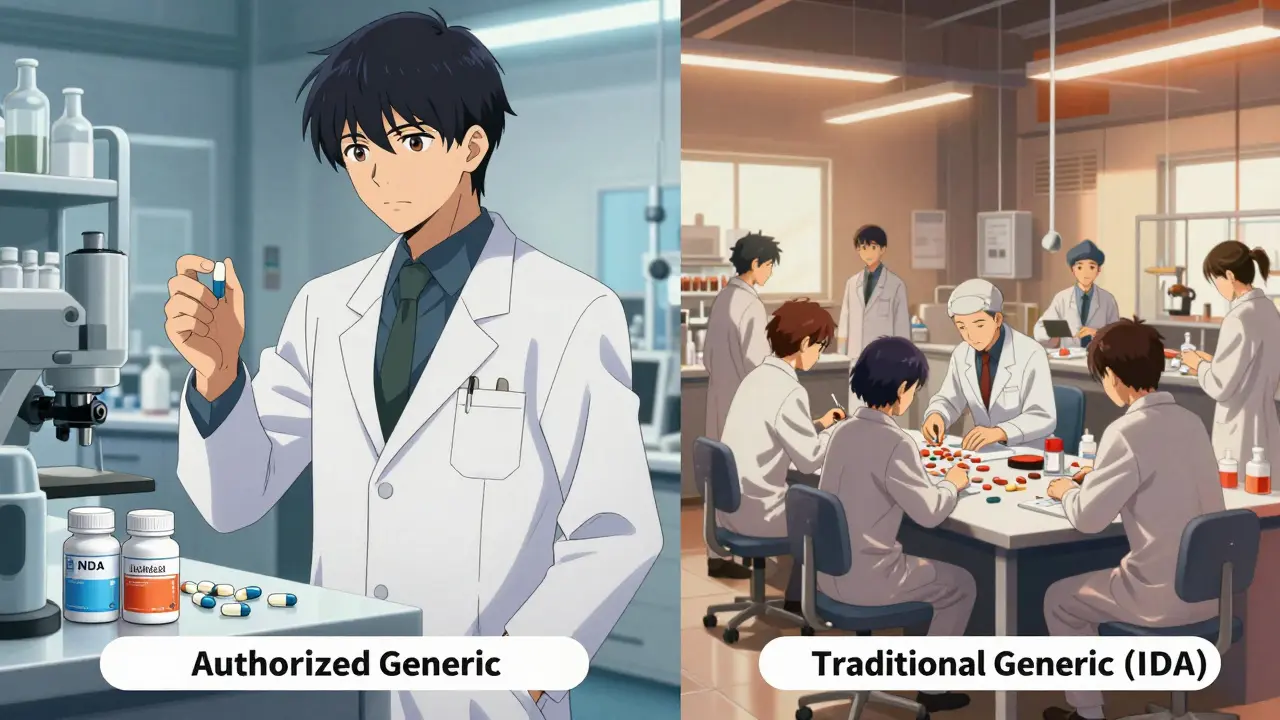
An authorized generic is, quite simply, the exact same drug product as the brand-name medication. It is manufactured by the original brand company under its own New Drug Application (NDA). The only difference is that it is sold without the brand name on the label. Think of it as a store-brand cereal made by the same factory that makes the famous national brand, using the exact same recipe, but packaged in a plain box.
According to the FDA, an authorized generic contains identical active and inactive ingredients as the brand-name drug. This means the filler, the dye, the binding agent, and the active medicinal compound are all the same. Because it is produced under the original NDA, it does not require separate FDA approval. The brand manufacturer simply notifies the FDA that they intend to market the product without the brand name.
This pathway allows brand companies to offer a lower-priced option while maintaining total control over quality and supply. For patients who have had adverse reactions to inactive ingredients in other generics, or those taking narrow therapeutic index drugs where precision matters, an authorized generic offers the peace of mind of the brand formulation at a reduced cost.
Traditional Generics: The Bioequivalent Standard
In contrast, a traditional generic (often just called a "typical generic") is developed by a different manufacturer after the brand-name patent expires or is challenged. These drugs must be bioequivalent to the brand-name drug. This means they must deliver the same amount of active ingredient into the patient's bloodstream within the same timeframe.
However, traditional generics do not need to have the same inactive ingredients. The color, shape, flavoring, or fillers may differ. To get approved, these manufacturers submit an Abbreviated New Drug Application (ANDA). They don't need to prove safety and efficacy from scratch because the FDA already established that for the brand drug. Instead, they prove that their version performs identically in the body.
For most medications, such as blood pressure pills or antibiotics, these minor differences in inactive ingredients make no clinical difference. But for some patients, particularly those with sensitivities or those on complex regimens, the switch to a traditional generic can sometimes result in perceived differences in efficacy or side effects.
Regulatory Pathways: NDA vs. ANDA
The legal and regulatory journey for these two drug types is fundamentally different. This distinction dictates how quickly they enter the market and how much data is required.
| Feature | Authorized Generic | Traditional Generic |
|---|---|---|
| Application Type | New Drug Application (NDA) | Abbreviated New Drug Application (ANDA) |
| FDA Approval Needed? | No (Notification only) | Yes (Full review) |
| Orange Book Listing | No | Yes |
| Patent Challenge | Not required | Often required for early entry |
| Manufacturing Site | Original Brand Facility | Generic Manufacturer Facility |
The absence of an ANDA requirement for authorized generics is a huge advantage for brand manufacturers. It saves years of development time and millions of dollars in clinical trials. However, it also means authorized generics are not listed in the FDA's Orange Book, the primary resource pharmacists use to check therapeutic equivalence. This can sometimes lead to confusion in pharmacies, where staff might not immediately recognize an authorized generic as therapeutically equivalent to the brand.
Market Timing and Strategic Launches
When do these drugs hit the market? Traditional generics typically wait until the brand patent expires, or they engage in a high-stakes legal battle to challenge the patent early. If a traditional generic wins a patent challenge, they receive 180 days of marketing exclusivity, meaning they are the only generic available for that period. This creates a massive financial incentive for generic companies to sue brand manufacturers.
Authorized generics, however, can enter the market at any time. Brand manufacturers often launch them strategically. Sometimes, they release an authorized generic just before a traditional generic enters the scene. This allows the brand company to capture the price-sensitive segment of the market-patients and insurers looking for cheaper options-without losing customers to a competitor. It’s a way to compete with themselves rather than handing market share to a rival.
Data from Health Affairs shows that between 2010 and 2020, 217 unique authorized generic products were launched in the U.S. The trend is accelerating as brands seek to protect revenue streams in a competitive landscape. You are likely to see more of these launches in 2026, particularly for oral solid drugs like tablets and capsules.
Cost Implications for Patients and Insurers
Why should you care about the type of generic? Cost is the biggest factor. Both authorized and traditional generics are significantly cheaper than brand-name drugs. However, authorized generics often sit in a middle ground. They are usually priced higher than traditional generics but lower than the brand name.
Insurance plans play a crucial role here. Many formularies now cover authorized generics instead of the brand name medicine, treating them similarly to traditional generics for reimbursement purposes. However, because authorized generics are not always clearly labeled as such on the pharmacy receipt, patients might not realize they are getting the brand-identical product. Some patients report being surprised when their copay drops, assuming they got a "different" drug, when in fact they received the exact same formulation as before.
For self-pay patients, the savings can be substantial. An authorized generic of a popular asthma medication, for example, might cost half as much as the brand but provides the identical therapeutic effect. This transparency in pricing can help reduce out-of-pocket expenses without compromising on the specific formulation a patient has grown accustomed to.

Clinical Considerations: Are They Interchangeable?
From a medical standpoint, the FDA considers authorized generics therapeutically equivalent to their brand-name counterparts. Since the ingredients are identical, there is no risk of therapeutic substitution issues. If you tolerated the brand well, you will tolerate the authorized generic well.
Traditional generics are also considered therapeutically equivalent, but the definition relies on bioequivalence ranges. For most drugs, this is perfectly safe. However, for narrow therapeutic index drugs-medications where a small change in dose can lead to toxicity or lack of efficacy, such as certain seizure medications or thyroid hormones-some clinicians prefer to keep patients on the same manufacturer. In these cases, an authorized generic is a safer bet than switching between different traditional generic manufacturers, as the formula never changes.
If you have experienced issues with traditional generics in the past, ask your pharmacist if an authorized generic is available. It might be the missing link that allows you to save money without sacrificing consistency.
How to Identify Which Generic You Have
Identifying an authorized generic can be tricky. Since they look like the brand drug (same color, same imprint) but lack the brand name, they can be confusing. Pharmacists are the best resource here. They can check the National Drug Code (NDC) against the FDA's list of authorized generic drugs, which is updated quarterly.
Traditional generics, on the other hand, are easily identified by their listing in the Orange Book and their distinct appearance compared to the brand. If your pill looks different from the brand you previously took, it is almost certainly a traditional generic. If it looks identical but has a different name or no name, it could be an authorized generic.
Don't hesitate to ask your pharmacist: "Is this an authorized generic or a traditional generic?" Most pharmacists appreciate the question and can provide clarity, especially if you have specific concerns about inactive ingredients.
Is an authorized generic safer than a traditional generic?
Both are safe and regulated by the FDA. However, an authorized generic is chemically identical to the brand-name drug, including inactive ingredients. A traditional generic is bioequivalent but may have different fillers or dyes. If you have allergies to specific inactive ingredients or take a narrow therapeutic index drug, an authorized generic offers the same consistency as the brand.
Do I need a new prescription for an authorized generic?
No. Your existing prescription for the brand-name drug can typically be filled with an authorized generic, depending on your state's substitution laws and your insurance formulary. The pharmacist can substitute it unless your doctor marked "Dispense As Written" (DAW).
Why are authorized generics not in the Orange Book?
The Orange Book lists drugs approved via the Abbreviated New Drug Application (ANDA) process. Authorized generics are marketed under the original brand's New Drug Application (NDA), so they do not undergo the ANDA process and are therefore not listed in the Orange Book. They are listed separately on the FDA's authorized generic list.
Can my insurance force me to take an authorized generic?
Many insurance plans prefer generics to save costs. They may cover an authorized generic instead of the brand name, often at the same low copay as a traditional generic. Check your plan's formulary to see how authorized generics are classified.
Are authorized generics available for all brand drugs?
No. Authorized generics are a strategic choice made by brand manufacturers. They are more common for oral solid drugs like tablets and capsules. Complex drugs like inhalers or injectables rarely have authorized generic versions due to manufacturing complexities.