
Imagine a life-saving medication that costs $500 a month. Now imagine the exact same medicine, made by a different company, costing just $15. That is the power of the Abbreviated New Drug Application (ANDA) process. It is the legal and regulatory pathway that allows generic drugs to enter the U.S. market, driving down costs and increasing access for millions of patients. But how does a generic manufacturer prove their pill is just as safe and effective as the original brand-name drug without spending billions on new clinical trials? The answer lies in a complex web of laws, scientific standards, and strategic maneuvering established decades ago.
If you are navigating the pharmaceutical industry, understanding the ANDA process is not optional-it is essential. Whether you are a regulatory affairs specialist, an investor, or a healthcare professional, knowing the rules of this game helps explain why some generics launch quickly while others face years of legal battles. This guide breaks down the legal requirements, the science behind the approval, and the real-world challenges manufacturers face today.
The Foundation: The Hatch-Waxman Act
To understand the ANDA, you have to look back to 1984. Before then, the system was broken. Brand-name companies held patents that blocked competition for too long, keeping prices high. Meanwhile, generic companies struggled to get approved because they had to repeat expensive safety studies that had already been done. President Ronald Reagan signed the Drug Price Competition and Patent Term Restoration Act, commonly known as the Hatch-Waxman Act, into law to fix this imbalance.
This legislation created the ANDA pathway. It allowed generic manufacturers to rely on the FDA’s previous finding that the brand-name drug-the Reference Listed Drug (RLD)-was safe and effective. In exchange, brand-name companies got patent term extensions to compensate for time lost during FDA review. It was a delicate deal designed to balance innovation with affordability. Today, that framework is responsible for saving U.S. consumers trillions of dollars. According to the Association for Accessible Medicines, generic competition has saved approximately $2.2 trillion over the past decade alone.
Core Legal and Scientific Requirements
Getting an ANDA approved isn’t just about filing paperwork. You must scientifically prove that your generic product is therapeutically equivalent to the RLD. The FDA’s Office of Generic Drugs (OGD) enforces strict criteria. Here is what you need to demonstrate:
- Identical Active Ingredients: Your drug must contain the same active ingredient as the RLD. There are rare exceptions, but they require a suitability petition under Section 505(j)(2)(C) of the Federal Food, Drug, and Cosmetic Act.
- Same Dosage Form and Strength: If the brand is a 10mg tablet taken orally, your generic must be a 10mg tablet taken orally. The route of administration and conditions of use must match exactly.
- Bioequivalence: This is the heart of the ANDA. You must show through pharmacokinetic studies that your drug enters the bloodstream at the same rate and extent as the brand. The FDA requires 90% confidence intervals for Cmax (peak concentration) and AUC (total exposure) to fall within 80-125% of the RLD.
- Chemistry, Manufacturing, and Controls (CMC): You must provide comprehensive documentation on how you make the drug. This includes manufacturing processes, quality control procedures, and stability data. The facility must adhere to Current Good Manufacturing Practices (cGMP).
- Labeling: The label must be identical to the RLD’s, except for minor differences like the manufacturer’s name or inactive ingredients.
All of this information must be submitted in Electronic Common Technical Document (eCTD) format. You also need to pay user fees under the Generic Drug User Fee Amendments (GDUFA). For fiscal year 2024, the fee for an original ANDA submission was $129,500. These fees fund the FDA’s review process, which aims to keep timelines predictable.
Patent Certifications: The Legal Minefield
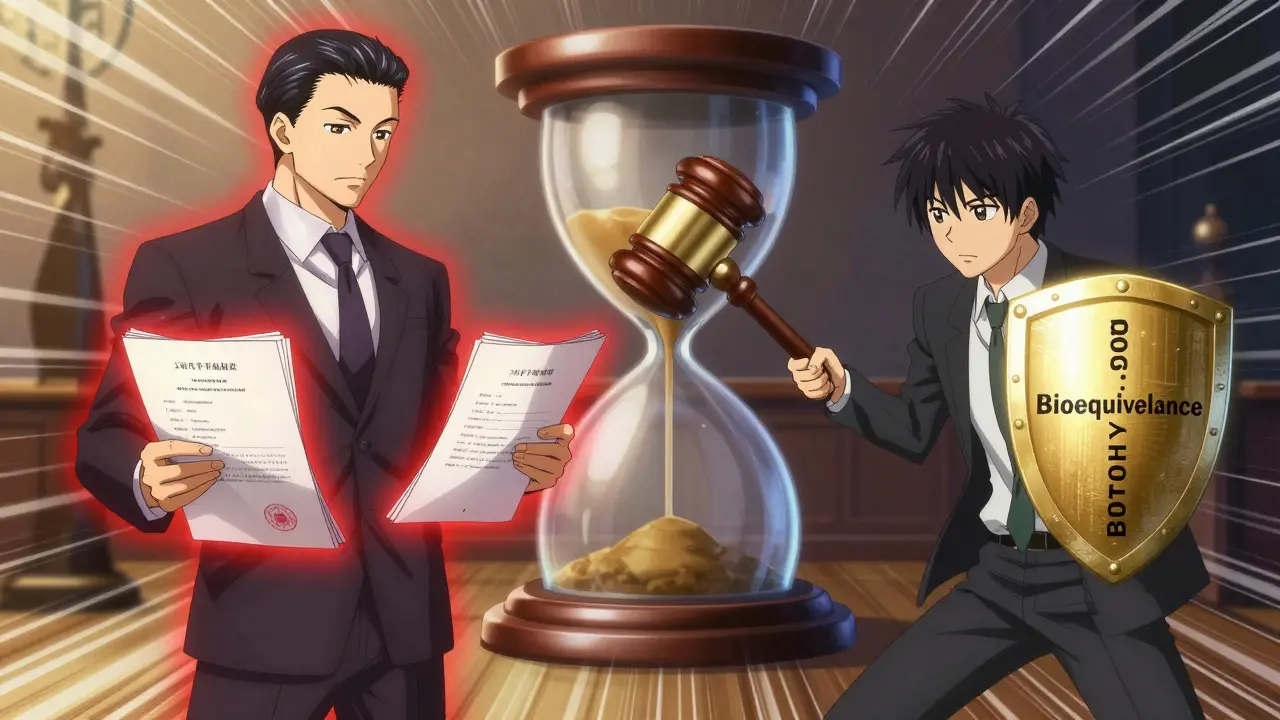
The science is only half the battle. The other half is legal. When you submit an ANDA, you must certify your stance on the patents listed for the RLD in the FDA’s Orange Book. There are four types of certifications, known as Paragraph I through IV.
| Certification Type | Description | Impact on Approval |
|---|---|---|
| Paragraph I | No patent information has been filed for the RLD. | FDA can approve immediately after review if no exclusivity bars exist. |
| Paragraph II | Patents have been filed, but they have expired. | FDA can approve immediately after review if no exclusivity bars exist. |
| Paragraph III | Patents are still valid, and approval is sought after expiration. | FDA cannot approve until the patent expires. |
| Paragraph IV | Patents are invalid, unenforceable, or will not be infringed. | Triggers a 30-month stay on FDA approval while litigation occurs. First filer may get 180 days of market exclusivity. |
Paragraph IV certifications are where the rubber meets the road. By claiming a brand’s patent is weak, you invite a lawsuit. Under Hatch-Waxman, the FDA pauses its approval clock for 30 months while the parties litigate. This delay can cost generic companies millions in development expenses. However, it is often worth the risk. The first generic to win a Paragraph IV case gets 180 days of exclusive marketing rights, allowing them to charge higher prices before other generics flood the market.
ANDA vs. NDA vs. 505(b)(2): Choosing the Pathway
Not every drug application fits neatly into the ANDA box. Understanding the differences between pathways helps clarify when an ANDA is the right choice.
A New Drug Application (NDA) is for entirely new chemical entities. It requires preclinical and clinical safety and efficacy data. This path takes 10-15 years and costs around $2.3 billion. An ANDA, by contrast, skips these clinical trials, taking 3-5 years and costing $5-10 million.
Then there is the 505(b)(2) NDA pathway. This is for products that differ from the RLD but can rely partially on existing data-for example, a new combination of two existing drugs or a change in dosage form. It sits in the middle, costing $50-100 million and taking 7-9 years. If your product is a straightforward copy of an off-patent drug, the ANDA is your best bet. If you need to change the formulation significantly, you might need a 505(b)(2) or a suitability petition.
Real-World Challenges and Delays
In theory, the process is streamlined. In practice, it is messy. Complex generics-like inhalers, topical creams, or nasal sprays-are particularly difficult. Proving bioequivalence for a drug that acts locally rather than systemically is scientifically challenging. The FDA’s 2022 report noted that only 42% of complex generic applications were approved on first review, compared to 78% for conventional tablets and capsules.
Manufacturing issues also cause major headaches. A senior regulatory affairs specialist shared on a pharmaceutical forum that many ANDAs are rejected solely due to inadequate container closure system validation data. If your packaging interacts with the drug, or if your stability data doesn’t cover all required time points, the FDA will issue a Complete Response Letter. Addressing these deficiencies can add months or even years to your timeline.
Brand-name companies also employ "evergreening" tactics. They file new patents for minor changes to their drugs, creating thickets that block generic entry. Between 2015 and 2020, brand manufacturers filed 1,450 patent applications for drugs already on the market. Navigating these legal barriers requires skilled patent attorneys and strategic planning.
The Future of Generic Approval
The landscape is evolving. GDUFA III, implemented in 2023, sets ambitious goals: 90% of standard ANDAs should be approved within 10 months, and priority generics within 8 months. The FDA is also investing in scientific tools for complex generics, allocating $15 million in 2024 to advance methods for evaluating products like inhalers.
Legislative efforts like the CREATES Act aim to prevent brand companies from blocking generic competition by withholding samples needed for testing. Meanwhile, the CARES Act pushes for new pathways for biosimilars, though that primarily affects the 351(k) pathway rather than traditional ANDAs. As AI-assisted document review becomes more common, we may see faster processing times. However, the core challenge remains: proving equivalence while navigating a legal minefield.
For generic manufacturers, success requires more than just chemistry. It demands deep regulatory expertise, robust manufacturing practices, and a willingness to engage in high-stakes litigation. For patients, the result is continued access to affordable medications that save lives and reduce healthcare costs.
What is the difference between an ANDA and an NDA?
An NDA (New Drug Application) is for new chemical entities and requires extensive clinical trials to prove safety and efficacy, costing billions and taking over a decade. An ANDA (Abbreviated New Drug Application) is for generic drugs and relies on the FDA's previous findings for the brand-name drug, requiring only proof of bioequivalence and identical manufacturing standards. ANDAs are much cheaper ($5-10 million vs $2.3 billion) and faster (3-5 years vs 10-15 years).
What does bioequivalence mean in the context of an ANDA?
Bioequivalence means that the generic drug enters the bloodstream at the same rate and to the same extent as the brand-name Reference Listed Drug (RLD). The FDA requires that the 90% confidence intervals for key pharmacokinetic parameters (Cmax and AUC) fall within 80-125% of the RLD values. This ensures the generic works just as well as the original.
How long does the ANDA approval process take?
Under GDUFA III goals, the FDA aims to approve 90% of standard ANDAs within 10 months and priority generics within 8 months. However, the actual timeline can vary. Complex generics or those facing patent litigation (especially Paragraph IV certifications) can take 30 months or longer due to legal stays and additional review cycles.
What is a Paragraph IV certification?
A Paragraph IV certification is a statement by a generic applicant that a patent listed in the Orange Book for the brand-name drug is invalid, unenforceable, or will not be infringed. Filing this certification triggers a 30-month stay on FDA approval while the brand company sues the generic maker. If the generic wins, it may receive 180 days of market exclusivity.
Why are complex generics harder to approve?
Complex generics, such as inhalers, topical creams, or nasal sprays, often act locally rather than systemically, making bioequivalence studies more difficult. Standard blood tests may not accurately reflect drug delivery. Additionally, device functionality (like an inhaler mechanism) adds another layer of complexity. Only 42% of complex generic applications are approved on first review, compared to 78% for simple tablets.
What is the role of the Orange Book in the ANDA process?
The FDA's Orange Book lists all approved drug products along with their patent and exclusivity information. Generic manufacturers use it to identify the Reference Listed Drug (RLD) and determine which patents they must address via Paragraph I-IV certifications. It is the primary resource for assessing legal barriers to generic entry.
How much does it cost to submit an ANDA?
The direct user fee for submitting an original ANDA in fiscal year 2024 was $129,500. However, total development costs range from $5 million to $10 million, covering bioequivalence studies, manufacturing setup, stability testing, and regulatory consulting. Complex generics can cost significantly more, sometimes exceeding $20-30 million.